B2C CRM vs B2B CRM: Which Industries Need CRM and How CXForge Helps Consumer Brands
Updated on:

Key findings
B2B CRM is built for companies that sell to other companies. It manages accounts, contacts, opportunities, lead nurturing, sales stages, and customer support history.
B2C CRM is built for companies that sell to individual consumers. It manages customer profiles, purchase behavior, loyalty status, preferences, consent, segments, and personalized campaigns at scale.
Industries that need B2B CRM include SaaS, professional services, manufacturing, wholesale distribution, commercial finance, real estate, logistics, agencies, telecom, healthcare vendors, and enterprise technology providers.
Industries that need B2C CRM include retail, fashion, ecommerce, restaurants, cafes, hotels, travel, grocery, beauty, wellness, entertainment, and consumer subscription brands.
CXForge works like a B2C CRM for loyalty-led consumer brands by unifying customer data, loyalty activity, segmentation, analytics, and activation across retention journeys.
CRM is not one category with one job.
A B2B CRM helps a company manage relationships with other companies: leads, accounts, contacts, opportunities, deals, buying committees, sales tasks, and support conversations. A B2C CRM helps a consumer brand manage relationships with individual customers: profiles, purchases, loyalty status, preferences, consent, campaign engagement, and retention journeys.
That difference matters because the data model is different. B2B CRM thinks in accounts and pipelines. B2C CRM thinks in customers, behavior, segments, and lifetime value.
For CXForge's audience, the important question is not "Do we need a CRM?" It is: "Do we need a sales CRM, or do we need a customer data and loyalty CRM that helps us retain thousands or millions of individual customers?"
If you run a retail, hospitality, food and beverage, or DTC brand, the answer is usually the second one.
What is a B2B CRM?
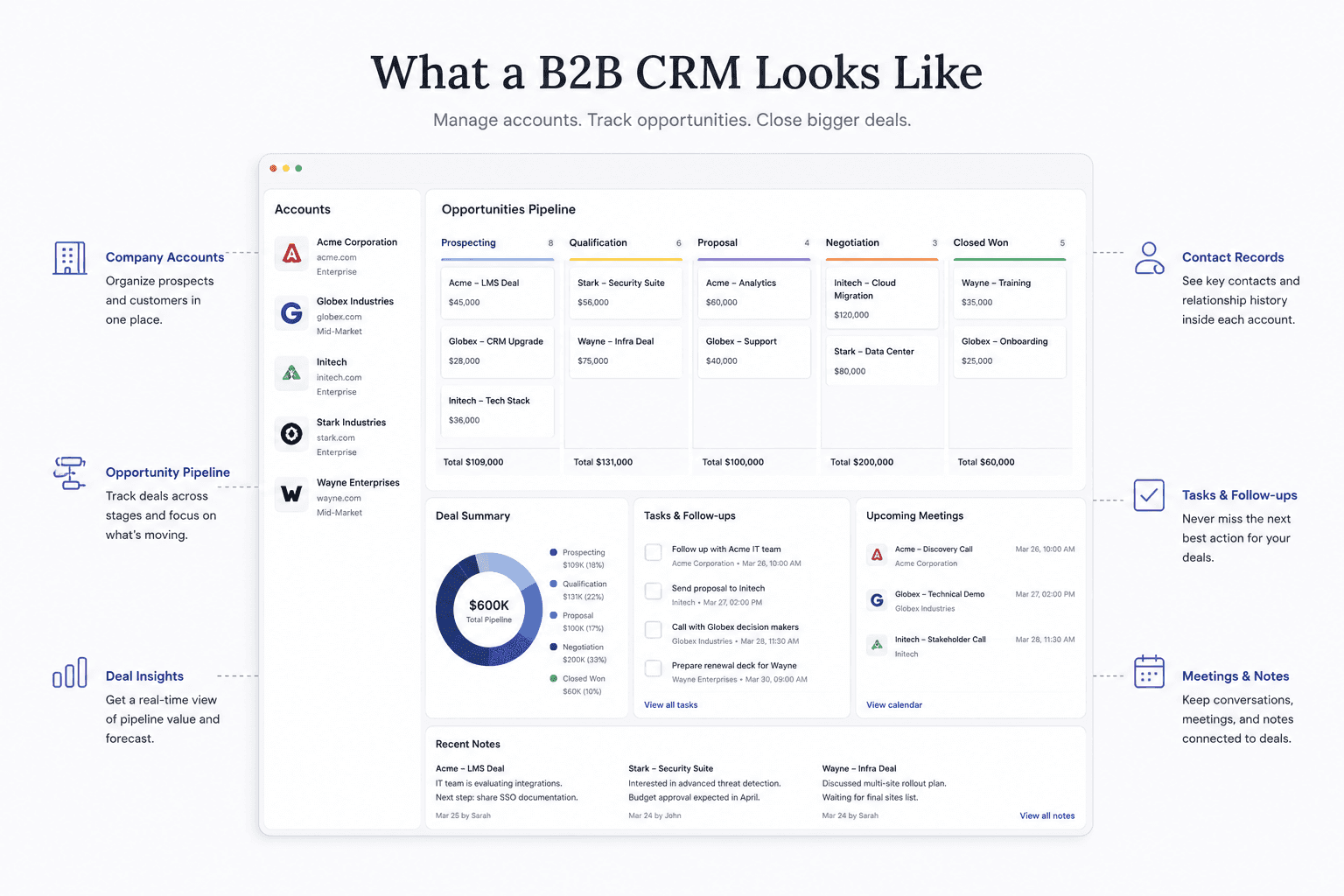
A B2B CRM, or business-to-business customer relationship management system, is software that helps companies manage relationships with other companies.
It usually stores and organizes:
Company accounts
Individual contacts inside those accounts
Sales opportunities
Lead source and lead score
Deal stage and pipeline value
Sales activities and follow-ups
Emails, calls, meetings, and notes
Contracts, renewals, and account health
Customer support or success history
The core job of a B2B CRM is to help sales, marketing, customer success, and support teams understand where each account stands and what should happen next.
For example, a SaaS company may use a B2B CRM to track a target account from first website conversion to discovery call, demo, proposal, security review, procurement, closed-won deal, onboarding, renewal, and expansion.
That is a relationship-heavy, multi-step, multi-person buying process.
What is a B2C CRM?
A B2C CRM, or business-to-consumer customer relationship management system, helps consumer brands manage relationships with individual customers at scale.
It usually brings together:
Customer identity: email, phone, loyalty ID, ecommerce account, app ID
Purchase history: orders, store visits, product categories, returns, average order value
Loyalty data: points, tiers, rewards, redemptions, member status
Engagement data: email, SMS, WhatsApp, push, app, web, campaign interactions
Preferences: favorite categories, preferred store, sizes, interests, dietary needs, travel preferences
Consent: opt-ins, opt-outs, privacy permissions, channel permissions
Segments: VIP, active, at risk, lapsed, new member, high-value, discount-sensitive
Analytics: lifetime value, frequency, recency, churn risk, campaign performance
The core job of a B2C CRM is to help retention, loyalty, CRM, ecommerce, and customer experience teams create more relevant customer journeys.
For example, a fashion retailer may use B2C CRM data to identify loyalty members who bought twice in-store but never purchased online, then send a personalized online offer based on their favorite category. A restaurant group may use it to recognize frequent guests, send reward reminders, and re-engage customers who have not visited in 60 days.
That is a volume-heavy, behavior-driven, personalization-focused relationship model.
B2B CRM vs B2C CRM: the practical difference
Area | B2B CRM | B2C CRM |
|---|---|---|
Primary relationship | Company account | Individual customer |
Typical buyer | Business, department, buying committee | Consumer, household, loyalty member |
Sales cycle | Longer, multi-stage | Shorter, high-volume |
Key data | Account, contact, opportunity, sales stage | Profile, purchase history, loyalty, preferences, segments |
Main users | Sales, marketing, customer success, support | CRM, loyalty, retention, ecommerce, CX, marketing |
Common workflows | Lead nurturing, deal tracking, account management | Segmentation, personalization, loyalty journeys, win-back campaigns |
Success metrics | Pipeline value, win rate, deal velocity, renewal rate | Repeat purchase rate, loyalty engagement, CLV, churn, redemption, retention |
Klaviyo's B2B CRM glossary makes the same broad distinction: B2B CRM supports longer sales cycles, lead nurturing, lead scoring, account-based marketing, and multiple stakeholders, while B2C CRM focuses on individual consumers, high-volume transactions, personalization, and loyalty-led retention.
The simplest way to remember it:
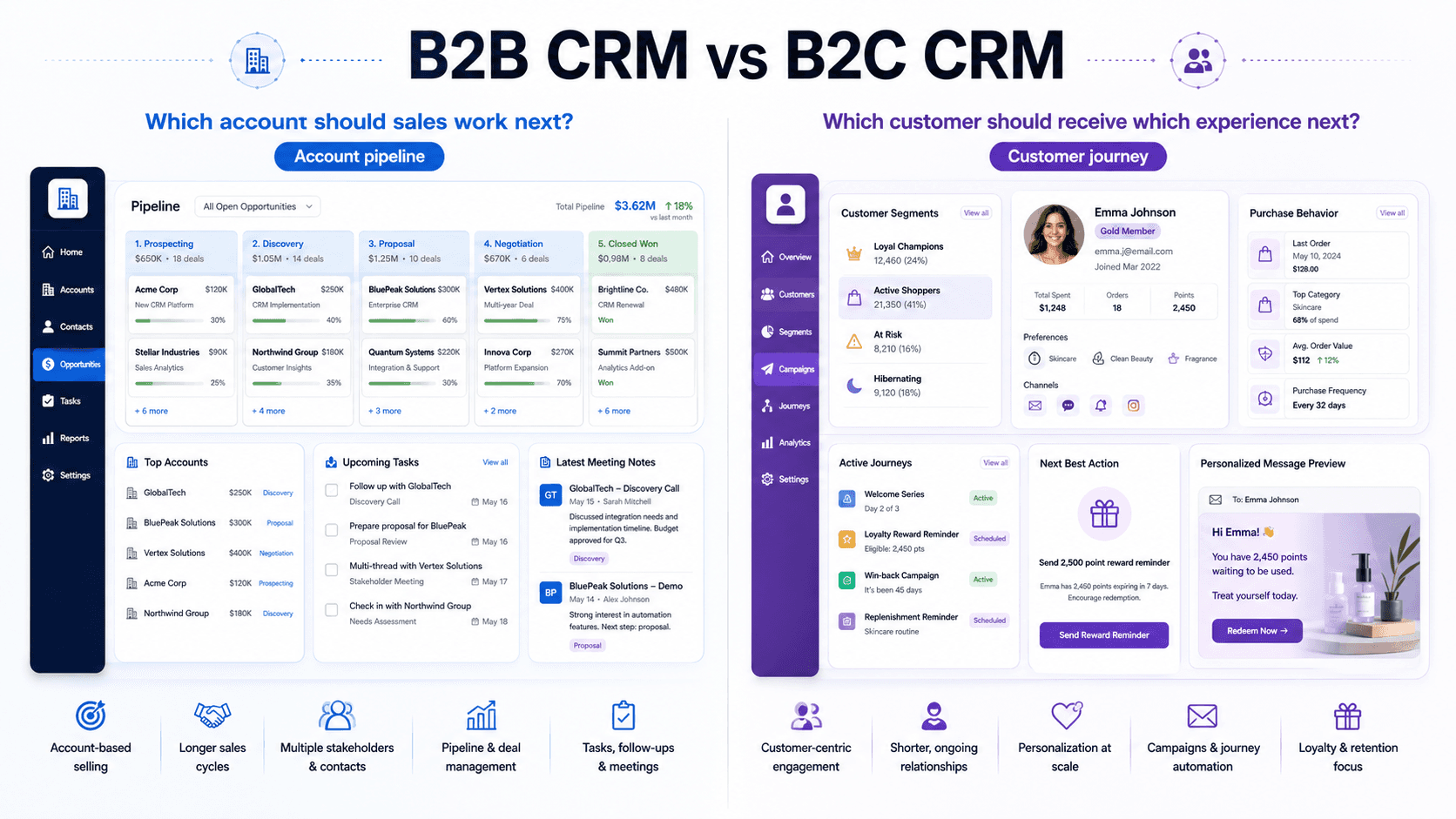
B2B CRM asks, "Which account should sales work next?"
B2C CRM asks, "Which customer should receive which experience next?"
Which industries need B2B CRM?
B2B CRM is useful for any business that sells to other businesses through a considered buying process.
Industry | Why B2B CRM matters |
|---|---|
SaaS and software | Tracks leads, demos, trials, opportunities, renewals, customer success, and expansion revenue. |
Professional services | Manages prospects, proposals, client relationships, project history, and referral pipelines. |
Agencies and consultancies | Tracks inbound leads, retainers, scopes, sales meetings, proposals, and account growth. |
Manufacturing | Manages distributors, enterprise buyers, channel partners, quotes, and long procurement cycles. |
Wholesale and distribution | Tracks buyer accounts, order frequency, pricing agreements, and sales rep activity. |
Logistics and supply chain | Manages enterprise accounts, contracts, operational contacts, and renewal opportunities. |
Commercial finance and insurance | Tracks business borrowers, brokers, underwriters, advisors, and compliance-heavy sales processes. |
Real estate and property services | Manages developers, tenants, investors, property managers, and broker relationships. |
Telecom and IT services | Tracks business accounts, technical stakeholders, service plans, implementations, and renewals. |
Healthcare technology and vendors | Manages clinics, hospitals, administrators, procurement teams, and implementation pipelines. |
Education technology | Tracks schools, universities, training providers, pilots, renewals, and multi-stakeholder decisions. |
These industries usually need B2B CRM because one "customer" is not just one person. The real relationship may include a decision maker, budget owner, technical evaluator, procurement manager, finance contact, end users, and executive sponsor.
Without a CRM, those relationships get scattered across inboxes, spreadsheets, sales notes, and individual memory.
Which industries need B2C CRM?
B2C CRM is useful for consumer brands that need to retain customers, personalize communication, and understand behavior across channels.
Industry | Why B2C CRM matters |
|---|---|
Retail and fashion | Connects POS, ecommerce, loyalty, returns, category preferences, and CRM campaigns. |
Grocery and convenience | Supports high-frequency offers, personalized pricing, household behavior, and reward redemption. |
Restaurants, cafes, and QSR | Tracks visit frequency, favorite locations, loyalty rewards, delivery behavior, and lapsed guests. |
Hospitality and hotels | Connects bookings, stay history, preferences, membership tier, service recovery, and repeat visits. |
DTC ecommerce | Unifies purchase behavior, email/SMS engagement, subscriptions, product affinity, and churn risk. |
Beauty and wellness | Supports replenishment journeys, treatment history, preference profiles, subscriptions, and memberships. |
Travel and experiences | Tracks bookings, travel preferences, loyalty status, offers, and lifecycle journeys. |
Entertainment and leisure | Connects ticketing, memberships, visits, preferences, and event-driven engagement. |
Consumer subscriptions | Manages onboarding, usage, replenishment, renewal risk, cancellation signals, and win-back journeys. |
Multi-location service brands | Connects location-level behavior with centralized customer profiles and campaign rules. |
These industries need B2C CRM because they do not just need to sell once. They need customers to return, identify themselves, join loyalty, redeem rewards, visit again, buy across channels, and feel recognized.
That requires a different kind of CRM foundation from a sales pipeline.
How CXForge works like a B2C CRM
CXForge is a loyalty and customer data platform for retail, hospitality, F&B, and DTC brands. It is not positioned as a generic sales CRM for B2B pipeline management. Its value is closer to B2C CRM: helping consumer brands understand customers, manage loyalty, and activate retention.
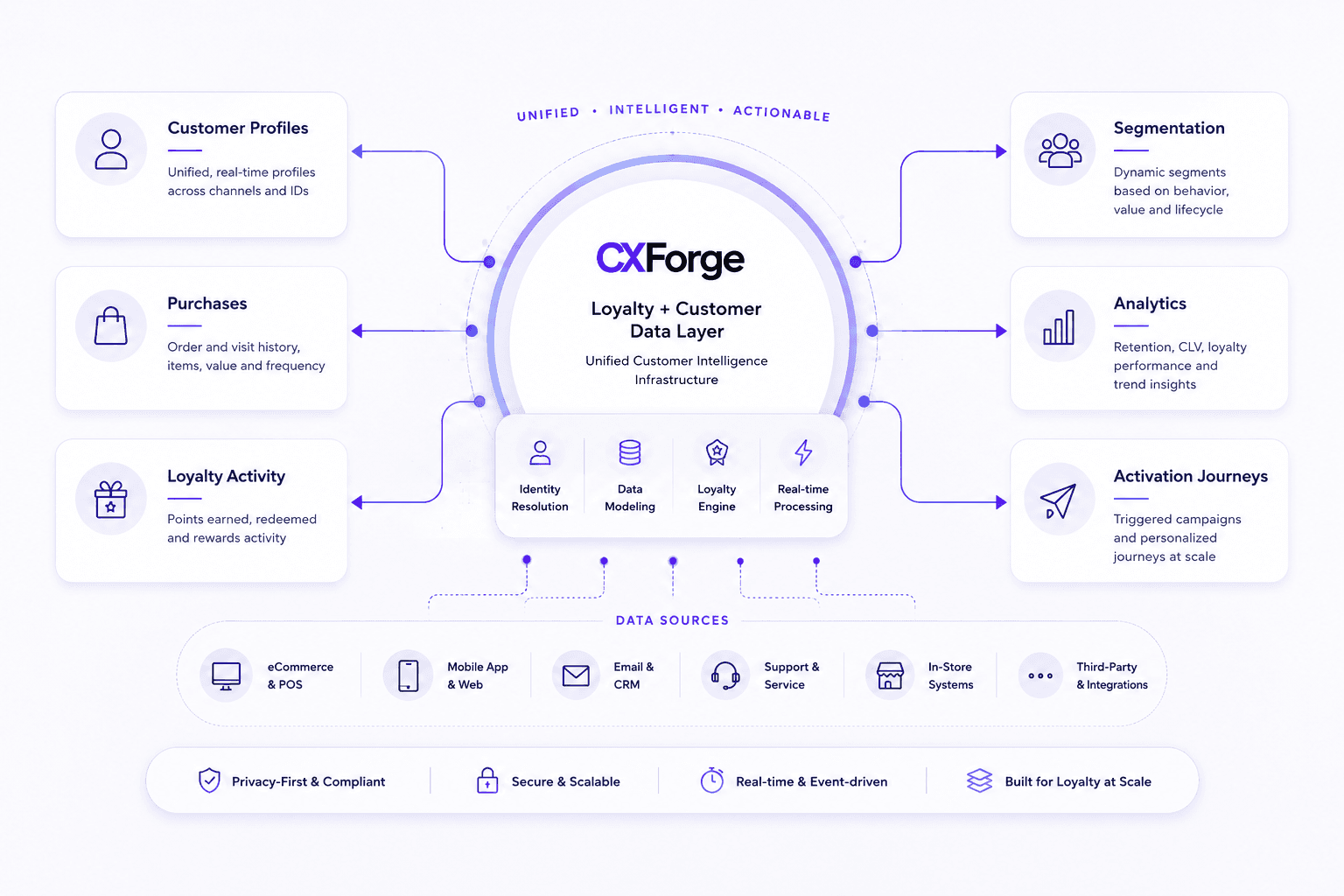
Here is how CXForge works like a B2C CRM for loyalty-led teams.
1. It creates a more useful customer view
B2C CRM starts with a customer profile that brings together the data a retention team needs to act.
For CXForge's target customers, that can include loyalty membership, purchase behavior, engagement, preferences, rewards, customer segments, and retention signals.
The goal is not to store data for its own sake. The goal is to help CRM and loyalty teams answer practical questions:
Who are our best customers?
Who is close to lapsing?
Which loyalty members have points but have not redeemed?
Which customers shop online and in-store?
Which customers should receive a reward, reminder, or recovery message?
Which segments are increasing customer lifetime value?
2. It connects loyalty with customer data
Many consumer brands treat loyalty as a points engine and CRM as a messaging tool. That creates a gap.
CXForge's positioning is stronger when loyalty and customer data work together. A loyalty program becomes more valuable when the brand can use customer data to personalize rewards, identify churn risk, trigger lifecycle journeys, and measure retention impact.
For example:
A restaurant can send a visit-frequency reward before a regular guest lapses.
A fashion retailer can recognize VIP members with early access instead of blanket discounts.
A hotel group can connect tier status with stay preferences and service recovery.
A DTC brand can personalize replenishment reminders based on product history.
That is B2C CRM thinking applied to loyalty.
3. It supports customer segmentation
B2B CRM segments accounts by industry, company size, deal stage, region, and account health.
B2C CRM segments customers by behavior, lifecycle, value, preferences, and loyalty status.
CXForge can fit into that second model by helping teams build and use customer segments such as:
New loyalty members
First-time buyers
Repeat buyers
VIP customers
At-risk customers
Lapsed customers
Points-ready members
High-frequency visitors
Category-specific buyers
Store-only or online-only customers
These segments let teams move beyond generic campaigns and create retention journeys that feel more relevant.
4. It helps teams activate CRM journeys
A B2C CRM should not end at reporting. It should help teams decide what to do next.
CXForge can support loyalty and retention journeys such as:
Loyalty onboarding
First-to-second purchase campaigns
Reward reminder campaigns
Tier progress nudges
Birthday or anniversary journeys
VIP recognition
Win-back campaigns
Store reactivation
Post-purchase cross-sell
Service recovery suppression or follow-up
This is where CXForge works like the operating layer between customer data, loyalty logic, and CRM execution.
5. It gives teams retention analytics
Sales CRM teams measure pipeline and revenue. B2C CRM teams measure retention and customer value.
For a consumer brand, useful CRM analytics include:
Repeat purchase rate
Customer lifetime value
Loyalty member engagement
Active vs lapsed members
Reward redemption rate
Segment performance
Campaign-driven revenue
Store vs ecommerce behavior
Churn risk
Offer effectiveness
These metrics help retention teams prove which loyalty and CRM activities are actually changing customer behavior.
When a brand needs B2B CRM, B2C CRM, or both
Some businesses need one CRM model. Some need both.
Business type | CRM need |
|---|---|
SaaS company selling to enterprises | B2B CRM |
Fashion retailer selling to shoppers | B2C CRM |
Restaurant chain managing guests | B2C CRM |
Agency selling services to clients | B2B CRM |
Manufacturer selling through distributors | B2B CRM |
Hotel group managing guests and corporate accounts | Both |
Wholesale brand selling to retailers and consumers online | Both |
Marketplace with merchants and shoppers | Both |
Franchise business managing franchisees and end customers | Both |
The key is to match the CRM to the relationship.
If the relationship is account-based, complex, and sales-led, use B2B CRM. If the relationship is customer-based, high-volume, and retention-led, use B2C CRM. If your business has both motions, connect both systems around clean customer and account data.
What to look for in a B2C CRM platform
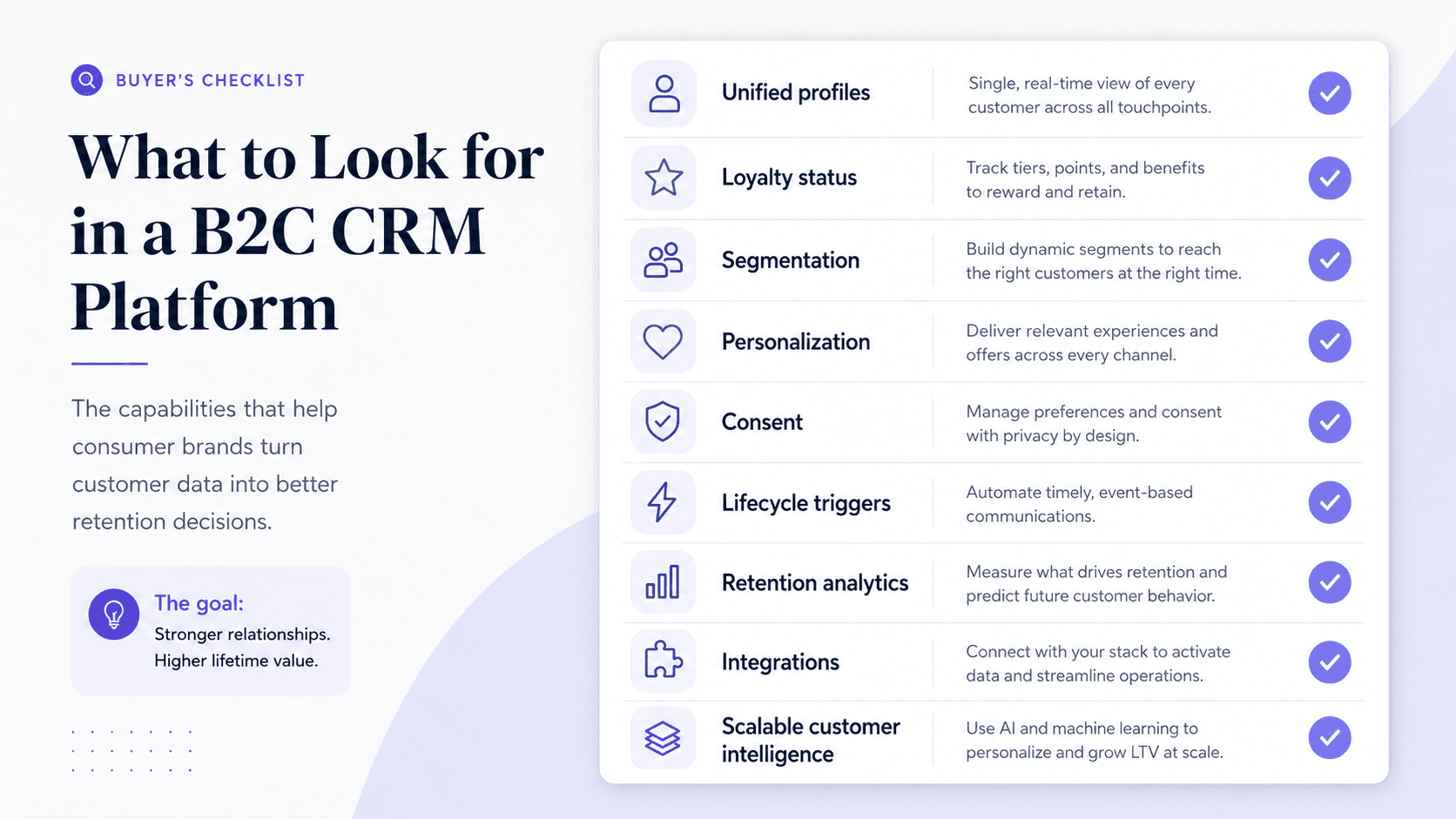
If you are evaluating B2C CRM software for a retail, hospitality, F&B, or DTC brand, look for capabilities that match how consumer relationships actually work.
Strong B2C CRM should help you:
Unify customer profiles across POS, ecommerce, loyalty, and messaging channels
Manage loyalty status, rewards, points, tiers, and redemptions
Segment customers without depending on analysts for every campaign
Personalize offers, campaigns, and customer journeys
Respect consent, opt-ins, and communication preferences
Trigger lifecycle journeys based on behavior
Measure retention, loyalty performance, and customer lifetime value
Integrate with the tools your team already uses
Scale from simple campaigns to more advanced customer intelligence
Do not choose a B2C CRM only because it has more fields, dashboards, or automation options. Choose it because it helps your team make better customer decisions every week.
How CXForge fits
CXForge is a strong fit when the main growth problem is not "we need more sales pipeline visibility." It is "we need to retain more customers, understand loyalty behavior, and activate better customer journeys."
That makes CXForge especially relevant for:
Retail and fashion brands with store and ecommerce data
Hospitality brands that want better guest recognition and retention
F&B groups that need visit-frequency, rewards, and location-based engagement
DTC brands trying to improve repeat purchase and lifecycle marketing
Multi-location consumer brands that need consistent CRM and loyalty execution
In simple terms, CXForge helps consumer brands bring the discipline of CRM into the loyalty and retention layer.
B2B CRM gives sales teams a clear view of accounts and opportunities. CXForge gives consumer-brand teams a clearer view of customers, loyalty behavior, segments, and retention opportunities.
FAQ
What is the difference between B2B CRM and B2C CRM?
B2B CRM manages relationships with business accounts, contacts, opportunities, and long sales cycles. B2C CRM manages relationships with individual customers at scale, using purchase behavior, loyalty data, preferences, segments, and personalized campaigns.
What industries need B2B CRM?
Industries that need B2B CRM include SaaS, professional services, agencies, manufacturing, wholesale distribution, logistics, commercial finance, real estate, telecom, healthcare vendors, education technology, and enterprise technology providers.
What industries need B2C CRM?
Industries that need B2C CRM include retail, fashion, ecommerce, restaurants, cafes, hotels, travel, grocery, beauty, wellness, entertainment, consumer subscriptions, and multi-location service brands.
Is CXForge a B2B CRM?
CXForge is not positioned as a traditional B2B sales CRM for managing account pipelines. CXForge works more like a B2C CRM and loyalty customer data platform for consumer brands that need customer profiles, loyalty data, segmentation, analytics, and retention activation.
How does CXForge help with B2C CRM?
CXForge helps retail, hospitality, F&B, and DTC brands connect loyalty with customer data. It supports CRM-style use cases such as customer segmentation, loyalty activation, reward reminders, win-back journeys, VIP recognition, and retention analytics.
Do retail brands need a CRM?
Yes. Retail brands need CRM when they want to understand customer behavior across stores, ecommerce, loyalty, and messaging channels. For most retailers, the right CRM is a B2C CRM or loyalty CRM rather than a traditional B2B sales CRM.
Can a company use both B2B CRM and B2C CRM?
Yes. A hotel group, marketplace, wholesale brand, franchise business, or hybrid ecommerce company may need both. B2B CRM manages account relationships, while B2C CRM manages end-customer engagement, loyalty, and retention.