LoyaltyLion vs Yotpo vs CXForge: Which Loyalty Platform Fits Your Retention Strategy?
Updated on:

LoyaltyLion vs Yotpo is a common comparison for ecommerce teams choosing customer loyalty software. Both names are familiar in Shopify and DTC retention conversations. Both can help brands launch rewards, referrals, and loyalty experiences. But the right decision is not only about which tool has more feature checkmarks.
The more useful question is: what kind of retention operating model are you trying to build?
If your loyalty program is mostly an ecommerce storefront layer, your evaluation will focus on points, tiers, referrals, integrations, onsite modules, and campaign touchpoints. If your loyalty strategy needs to connect customer identity, transactions, segmentation, offers, campaigns, analytics, and partner or offline behavior, you need to evaluate the platform as part of a wider customer data and engagement system.
That is where CXForge enters the comparison. CXForge is positioned as a loyalty plus customer data platform for consumer brands that need retention infrastructure, not just a rewards app. This guide compares LoyaltyLion, Yotpo, and CXForge by use case, buyer fit, data model, campaign workflows, analytics, and implementation considerations.
Key Findings
Choose LoyaltyLion when the main job is ecommerce loyalty for a Shopify-led brand and the team wants a mature loyalty layer around points, tiers, referrals, and onsite loyalty engagement.
Choose Yotpo when loyalty needs to sit beside reviews, SMS, email, subscriptions, and ecommerce marketing tools inside a broader Yotpo ecosystem.
Choose CXForge when the retention problem is less about adding another points widget and more about unifying customer data, loyalty logic, segmentation, campaigns, and analytics across retail, hospitality, F&B, or DTC operations.
The best choice depends on operating complexity: ecommerce-only teams often evaluate app depth and storefront fit; mid-market consumer brands should also evaluate identity, data quality, lifecycle campaigns, reporting, and implementation ownership.
Pricing tables are less useful than workflow fit. Ask whether your team can launch segments, offers, experiments, and retention journeys without engineering support every time.
Quick Answer: LoyaltyLion vs Yotpo vs CXForge
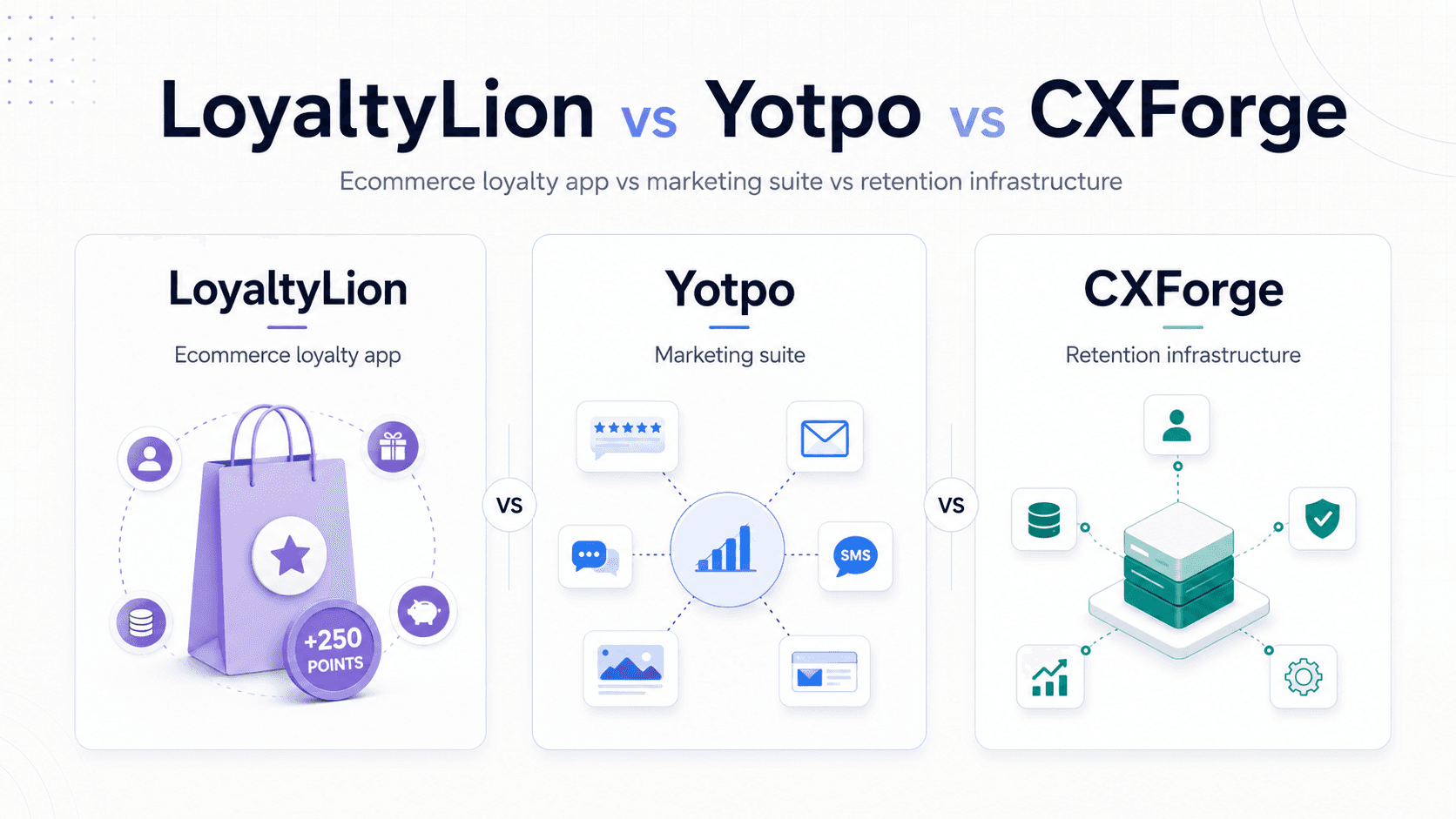
Platform | Best fit | Strongest reason to consider it | Watch-outs to evaluate |
|---|---|---|---|
LoyaltyLion | Shopify-led ecommerce brands that want a dedicated loyalty and referral platform | Focused loyalty program depth for points, tiers, referrals, and ecommerce retention | Confirm fit if customer data, offline behavior, multi-brand logic, or custom lifecycle workflows are central requirements |
Yotpo | Ecommerce teams already using or considering Yotpo's connected marketing suite | Loyalty can sit beside reviews, SMS, email, subscriptions, and ecommerce marketing workflows | Confirm whether the suite approach matches your data architecture, cost model, and flexibility needs |
CXForge | Mid-market consumer brands that need loyalty connected to customer data, segmentation, campaigns, and analytics | Loyalty, customer profiles, retention journeys, and measurement can be planned as one operating system | Best evaluated through a workflow and data audit rather than a generic app-store feature checklist |
In simple terms: LoyaltyLion is often a strong dedicated ecommerce loyalty choice. Yotpo is often attractive when a team wants loyalty inside a broader ecommerce marketing suite. CXForge is the better fit when loyalty needs to become a customer data and retention engine across more of the business.
What LoyaltyLion Is Usually Used For
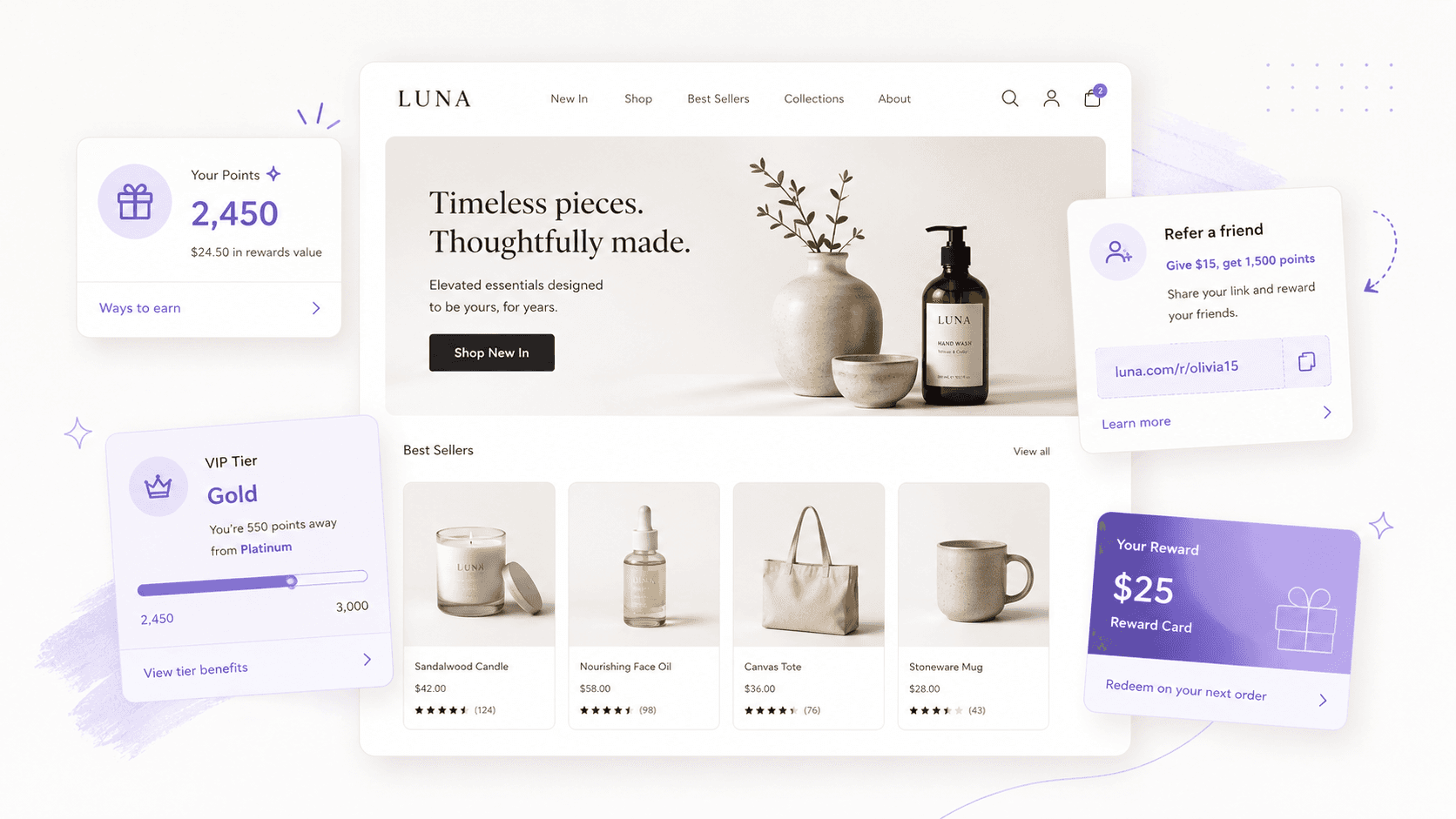
LoyaltyLion is widely considered by ecommerce brands that want a dedicated loyalty platform. Teams typically evaluate it when they need to launch or improve:
Points programs
VIP tiers
Referral incentives
Reward rules
Onsite loyalty modules
Ecommerce loyalty campaigns
Shopify-centered loyalty experiences
For many DTC brands, this is a practical starting point. The team wants to reward purchases, encourage referrals, increase repeat buying, and give customers a reason to create an account or return to the store.
Where LoyaltyLion tends to make sense:
The business is primarily ecommerce.
Shopify or ecommerce platform integration is a major decision factor.
Loyalty is owned by the ecommerce, retention, or CRM team.
The team wants a dedicated loyalty tool rather than a broad enterprise CDP.
Program mechanics are points, tiers, rewards, and referrals rather than complex partner settlement or offline identity resolution.
Questions to ask before choosing LoyaltyLion:
Can the platform support the exact tier, points, and reward logic your program needs?
How well does it connect loyalty behavior to your email, SMS, analytics, and customer support workflows?
Can your team segment members by value, behavior, risk, reward balance, and lifecycle stage?
What happens if you later need store, marketplace, POS, wholesale, partner, or multi-region behavior in the same loyalty view?
How much implementation support will you need to launch without creating a fragile stack of workarounds?
What Yotpo Is Usually Used For
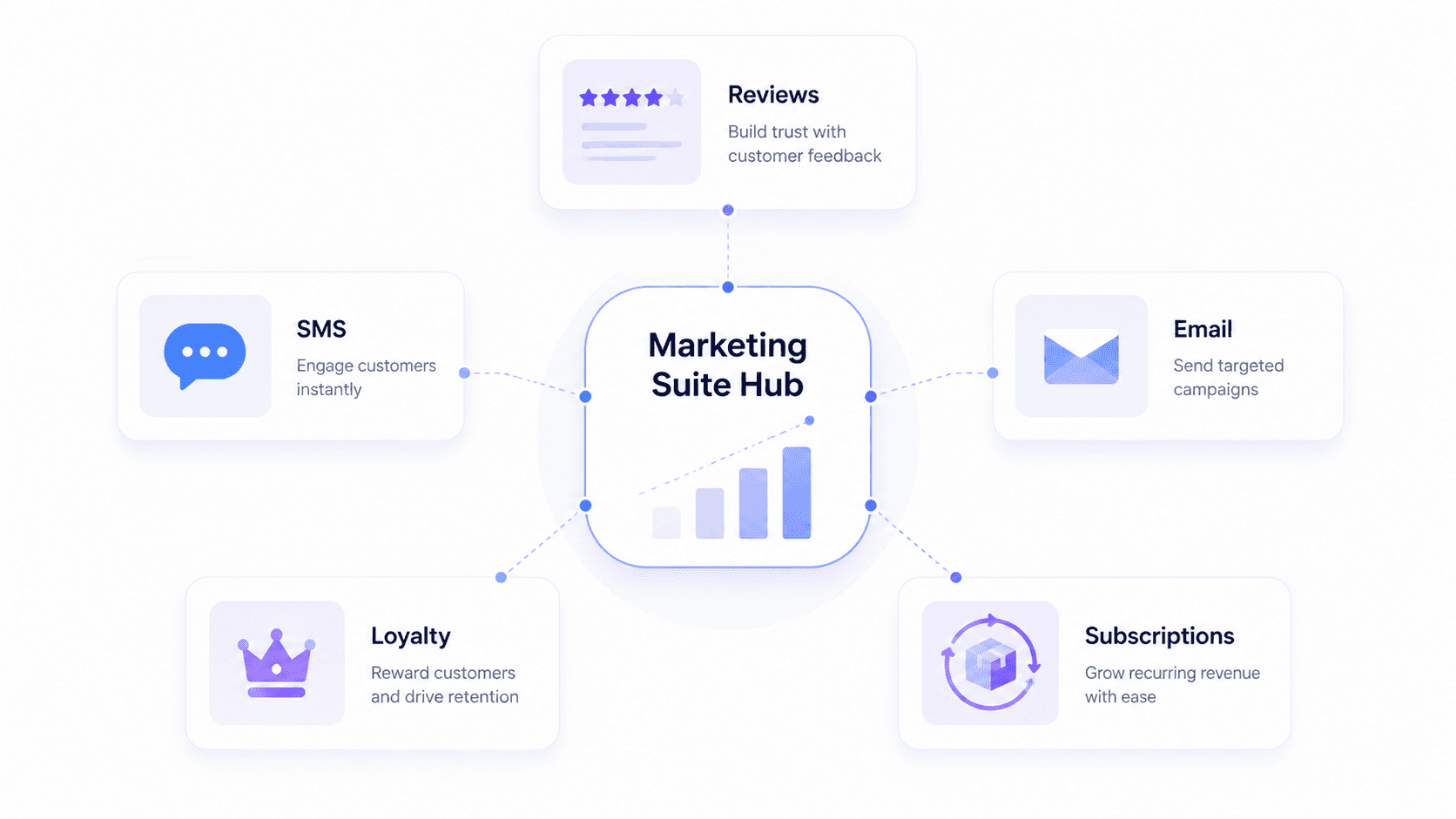
Yotpo is often evaluated by ecommerce teams that want loyalty and referrals as part of a broader marketing ecosystem. Its public positioning spans areas such as reviews, SMS, email, subscriptions, and loyalty. That makes it a natural option for brands that want fewer vendors across their ecommerce retention stack.
Where Yotpo tends to make sense:
The brand already uses Yotpo for reviews, SMS, email, or related ecommerce marketing workflows.
The team values a connected vendor ecosystem.
Loyalty is closely tied to customer reviews, referral campaigns, SMS/email journeys, subscriptions, and ecommerce conversion.
The program is ecommerce-first and mostly lives inside the digital shopping journey.
The suite model can be useful because loyalty rarely works alone. A reward is only valuable if the customer sees it, understands it, and receives timely prompts to use it. A loyalty signal is only useful if the team can act on it through campaigns and onsite personalization.
Questions to ask before choosing Yotpo:
Which parts of the Yotpo suite will your team actually use?
Does the combined suite simplify operations, or does it introduce more modules than your team needs?
How portable is your customer, loyalty, review, and campaign data if your stack changes later?
Can you build the loyalty segments and lifecycle workflows you need without heavy manual exports?
Does the pricing model still make sense once you include every module required for the full retention workflow?
Where CXForge Fits Differently
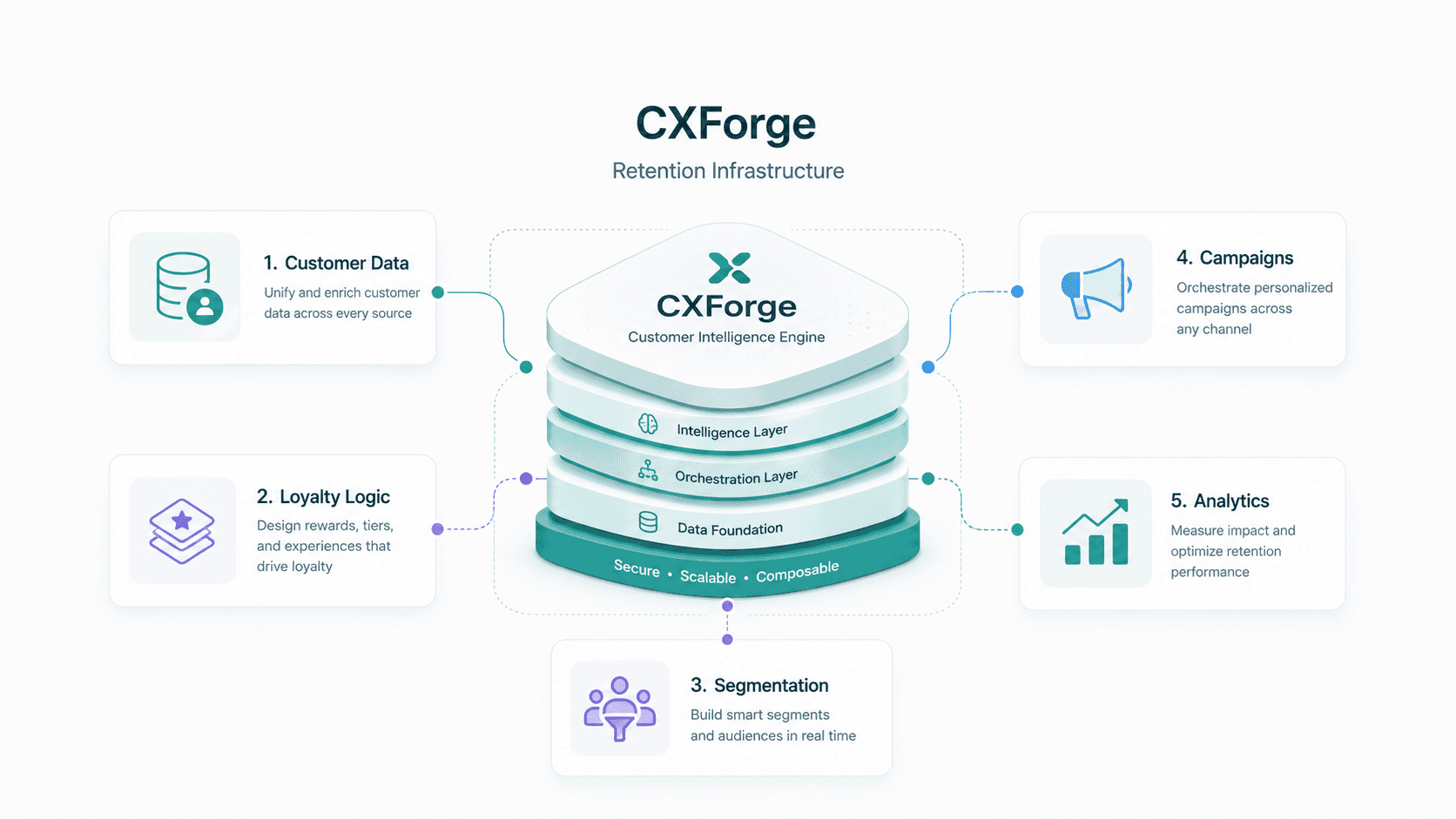
CXForge should be evaluated when the problem is not just "we need loyalty points." The stronger CXForge fit is: "we need a retention system that connects loyalty, customer data, segmentation, campaigns, and measurement."
That matters for consumer brands where repeat behavior happens across multiple contexts:
Retail customers shop in store and online.
Hospitality guests book, dine, visit, and respond to service moments.
F&B customers order from apps, counters, delivery channels, and stored-value wallets.
DTC brands need to connect product preferences, order history, discount behavior, subscription status, and member engagement.
Multi-location operators need central customer intelligence with local offer control.
In these cases, a loyalty program is not only a reward layer. It becomes the customer memory of the business.
CXForge is positioned for teams that want to answer questions like:
Who are our most valuable members?
Which customers are at risk of lapsing?
Which segments respond to rewards, points, benefits, offers, or recognition?
Which campaigns create profitable repeat behavior instead of discount dependency?
How do loyalty status, customer profile, transaction history, and campaign engagement connect?
Which retention workflows should the team automate before spending more on acquisition?
Feature Comparison: What To Evaluate Beyond The Checklist
Most loyalty platform comparisons become too shallow because they focus on visible features: points, tiers, referrals, rewards, and integrations. Those matter, but they do not tell you whether the platform will fit your retention operating model.
Use this evaluation framework instead.
Capability | Why it matters | What to ask LoyaltyLion | What to ask Yotpo | What to ask CXForge |
|---|---|---|---|---|
Loyalty mechanics | Points, tiers, referrals, rewards, and benefits are the foundation | How configurable are earn, burn, tier, and referral rules? | How do loyalty and referrals work with other Yotpo modules? | How are loyalty rules connected to customer profiles and segments? |
Customer data | Loyalty gets stronger when it uses complete customer context | Which customer attributes and behaviors are available for segmentation? | How does data move between loyalty, reviews, SMS, email, and ecommerce data? | How does CXForge unify member, transaction, behavior, and campaign data? |
Segmentation | Teams need to act on member differences, not blast every member | Can marketers build segments by spend, points, tier, risk, and engagement? | Can suite-level data power loyalty and campaign segments? | Can teams build loyalty segments tied to lifecycle, value, channel, and behavior? |
Campaign execution | Rewards only matter when customers receive the right prompt | How does the platform trigger campaigns through connected channels? | How do loyalty signals trigger SMS, email, and other Yotpo workflows? | How do loyalty signals, offers, and lifecycle campaigns work together? |
Analytics | Teams need to know if loyalty changes behavior profitably | What reports separate member growth from repeat purchase and margin impact? | Which suite analytics connect loyalty with reviews, messaging, and revenue? | Can reporting connect loyalty behavior, cohorts, retention, offers, and campaign performance? |
Implementation | A good platform still fails if launch ownership is unclear | What setup, migration, and support are included? | What implementation help is needed across modules? | What data mapping, program design, and retention workflow planning are required? |
Future flexibility | Loyalty programs evolve after launch | Can the program expand beyond current ecommerce use cases? | Can the team change modules or data flows without rework? | Can the platform support broader customer data and retention use cases over time? |
Ecommerce-Only Loyalty Vs Retention Infrastructure
The biggest strategic difference is whether you need an ecommerce loyalty app or retention infrastructure.
An ecommerce loyalty app is often enough when:
Most transactions happen through one online store.
The loyalty program is mostly points, tiers, discounts, referrals, and account engagement.
The main channels are onsite prompts, email, SMS, and ecommerce automations.
The team wants fast launch and low operational complexity.
Retention infrastructure becomes more important when:
Customers interact across multiple channels, stores, brands, or regions.
The team needs to unify fragmented customer data.
Segmentation and personalization are becoming more important than generic points.
Loyalty needs to connect to offer governance, lifecycle campaigns, churn prevention, and analytics.
The business wants to reduce discount dependency and measure true incremental retention.
This distinction prevents a common mistake: buying a platform for today's loyalty widget while ignoring tomorrow's customer data problem.
When LoyaltyLion Is The Better Choice
LoyaltyLion may be the stronger fit if your team wants a dedicated ecommerce loyalty platform and your program requirements are centered on Shopify-led loyalty execution.
It is especially worth evaluating when:
You want a focused loyalty and referral vendor.
Your ecommerce stack is already well-defined.
The program is not trying to solve wider customer data unification.
Your team wants loyalty mechanics that can be managed by ecommerce or retention marketers.
You care about reward visibility, account engagement, referrals, and repeat purchase.
LoyaltyLion may be less ideal if your loyalty strategy depends on many disconnected data sources, offline behavior, custom partner logic, or a broader customer intelligence layer.
When Yotpo Is The Better Choice
Yotpo may be the stronger fit if your team wants loyalty to sit inside a wider ecommerce marketing suite. This can be attractive when reviews, SMS, email, referrals, and loyalty are all active parts of the retention plan.
It is especially worth evaluating when:
You already use Yotpo products.
You want fewer vendors across reviews, messaging, loyalty, and ecommerce retention.
Your team benefits from suite-level workflows.
Loyalty is strongly tied to review generation, referral moments, SMS/email campaigns, and ecommerce conversion.
Yotpo may be less ideal if your team wants a more independent loyalty data architecture, has complex offline or multi-entity requirements, or only needs loyalty without the wider suite.
When CXForge Is The Better Choice
CXForge may be the stronger fit when loyalty is part of a broader retention and customer data strategy.
It is especially worth evaluating when:
You need loyalty connected to customer profiles, transaction history, segments, campaigns, and reporting.
Your brand operates across retail, hospitality, F&B, DTC, or multi-location contexts.
Your team wants to understand customer behavior before over-investing in rewards mechanics.
You need segmentation such as VIP, lapsing, new member, high-AOV, points-rich, tier-near, discount-sensitive, and omnichannel customers.
You want loyalty to guide lifecycle campaigns, not just issue points after purchases.
You need implementation thinking around data, workflows, and measurement, not only an app install.
CXForge is a better fit for teams asking: "How do we run retention smarter?" rather than only: "How do we add a rewards program?"
Decision Framework: How To Choose In One Workshop
Before booking vendor demos, run a 60-minute internal workshop. This prevents platform demos from defining your requirements for you.
1. Map Your Customer Journeys
List the places where customers buy, identify themselves, redeem, receive messages, and contact support. Include ecommerce, POS, mobile app, delivery, booking, WhatsApp, email, SMS, marketplace, and customer service where relevant.
If the journey is mostly ecommerce, LoyaltyLion or Yotpo may be enough. If the journey crosses channels and data systems, CXForge deserves a closer look.
2. Define The Loyalty Job
Be specific. "Improve retention" is too broad.
Better loyalty jobs include:
Increase second purchase rate.
Reduce lapse among high-value customers.
Grow repeat visits in a multi-location business.
Shift members from discount-only behavior to benefits and recognition.
Convert anonymous buyers into known profiles.
Use loyalty data to trigger lifecycle campaigns.
Connect offline and online behavior for better personalization.
3. Score Your Data Readiness
Ask where the following data lives today:
Customer profile
Consent and communication preferences
Purchase history
Returns or cancellations
Points balance
Tier status
Reward redemptions
Campaign engagement
Referral activity
Product or category affinity
Store, channel, or location behavior
If these live in too many disconnected systems, the platform evaluation should focus heavily on data architecture.
4. Design Three Launch Segments
A loyalty program should not launch with one generic member audience. Define the first three segments you want to treat differently.
For example:
Segment | Signal | Campaign idea | KPI |
|---|---|---|---|
New members with one purchase | Joined recently, no second order | Welcome journey with education and starter reward | Second purchase rate |
Points-rich inactive members | High points balance, no recent activity | Reminder with relevant redemption options | Reactivation rate |
Tier-near customers | Close to next tier threshold | Progress reminder and benefit preview | Tier progression rate |
If a platform cannot support your first three segments cleanly, it may not fit your operating model.
5. Ask For A Workflow Demo, Not A Feature Tour
Ask each vendor to demonstrate a real workflow:
Import or identify a customer.
Assign loyalty status and points.
Segment the customer based on behavior.
Trigger a campaign or offer.
Track redemption or repeat purchase.
Report whether the campaign worked.
This is more revealing than a generic product demo.
Common Mistakes In This Comparison
Mistake 1: Comparing Only Points And Tiers
Points and tiers are table stakes. The real question is whether the platform helps your team make better retention decisions.
Mistake 2: Ignoring Data Ownership
Loyalty programs generate valuable first-party data. Before choosing any platform, understand what data you can export, how identity is managed, and how loyalty signals flow into the rest of your stack.
Mistake 3: Buying A Suite Because It Looks Simpler
A suite can reduce vendor sprawl, but only if the suite matches the way your team works. Otherwise, you may pay for modules you do not use or accept workflow limits that become expensive later.
Mistake 4: Choosing The Cheapest Launch Option
The lowest starting cost can become expensive if the team later needs custom data work, manual exports, duplicate campaign tools, or a platform migration.
Mistake 5: Treating Loyalty As A Promotion Engine
If every loyalty action is a discount, the program can train customers to wait. Strong loyalty platforms should support recognition, access, personalization, progress, service recovery, and member utility, not only coupons.
Recommended Shortlist By Scenario
Scenario | Best first shortlist |
|---|---|
Shopify DTC brand launching first points and referrals program | LoyaltyLion, Yotpo |
Ecommerce team already using Yotpo reviews or SMS | Yotpo, then compare with LoyaltyLion if dedicated loyalty depth matters |
Mid-market brand with retail, ecommerce, and CRM data silos | CXForge, plus any ecommerce loyalty app only if storefront-specific mechanics are needed |
Hospitality or F&B brand connecting visits, preferences, rewards, and lifecycle campaigns | CXForge |
Brand wanting one vendor for reviews, SMS/email, subscriptions, loyalty, and referrals | Yotpo |
Retention team building segmentation, campaign, and analytics workflows around loyalty data | CXForge |
Ecommerce brand wanting a focused loyalty and referral vendor | LoyaltyLion |
How CXForge Should Position This Comparison
CXForge should not try to win every LoyaltyLion vs Yotpo search by claiming to be the same kind of tool. That would make the comparison less credible.
The better position is:
LoyaltyLion and Yotpo are credible ecommerce loyalty options.
The right choice depends on whether the buyer needs ecommerce loyalty execution, a marketing suite, or connected retention infrastructure.
CXForge is strongest when the buyer has loyalty plus customer data complexity: segmentation, lifecycle journeys, analytics, cross-channel behavior, and operational retention workflows.
That positioning is more useful for buyers and more defensible for the Publish Agent.
FAQ
Is LoyaltyLion better than Yotpo?
LoyaltyLion may be better when a brand wants a dedicated ecommerce loyalty and referral platform. Yotpo may be better when the team wants loyalty connected to a broader suite that can include reviews, SMS, email, subscriptions, and ecommerce marketing workflows.
What is the main difference between LoyaltyLion and Yotpo?
The main difference is operating model. LoyaltyLion is usually evaluated as a focused loyalty platform, while Yotpo is often evaluated as part of a broader ecommerce marketing suite. The better fit depends on your stack, data needs, and campaign workflows.
When should a brand consider CXForge instead of LoyaltyLion or Yotpo?
A brand should consider CXForge when loyalty needs to connect with customer data, segmentation, lifecycle campaigns, analytics, and cross-channel behavior. CXForge is especially relevant for retail, hospitality, F&B, DTC, and multi-location teams that need retention infrastructure rather than only ecommerce rewards mechanics.
Can CXForge replace a loyalty app?
CXForge can be evaluated as the core loyalty and customer data layer when the team needs profiles, rewards logic, segmentation, campaigns, and analytics connected. Some ecommerce teams may still use storefront-specific apps alongside a broader customer data and retention strategy, depending on the stack.
What should we ask in a LoyaltyLion or Yotpo demo?
Ask each vendor to show a full workflow: customer identification, points or tier update, segment creation, campaign trigger, redemption tracking, and reporting. A workflow demo reveals more than a static feature checklist.
What is the best loyalty platform for ecommerce brands?
The best ecommerce loyalty platform depends on program complexity. Shopify-led teams often compare LoyaltyLion and Yotpo. Brands with broader customer data, segmentation, and lifecycle campaign needs should also evaluate CXForge or another platform designed around retention infrastructure.