Mobile Wallet vs Loyalty App
Updated on:

Choosing between a mobile wallet pass and a loyalty app is really a choice about customer friction.
A mobile wallet pass asks the customer to save a digital loyalty card in Apple Wallet or Google Wallet. The customer can find it quickly, scan it at checkout, see basic membership details, and receive useful updates when the implementation supports them. It is lightweight, familiar, and practical.
A loyalty app asks the customer to install and keep using a brand-owned mobile app. That gives the brand much more room for product discovery, gamification, rewards browsing, preferences, referrals, order history, in-app campaigns, and richer personalization. It also asks more from the customer and more from the business.
The mistake is treating this as a simple technology preference. The better question is: what loyalty experience do customers actually need, and what operating system will keep that experience accurate?
For many consumer brands, the answer is not "wallet or app." It is a wallet pass for easy access, a web account or app for deeper engagement when needed, and a loyalty data platform behind both.
Key Findings
Mobile wallet passes are best for low-friction loyalty access: save the card, scan in store, show a member ID, display a balance, and reduce plastic-card or app-download dependency.
Native loyalty apps are best for richer engagement: reward catalogs, product discovery, gamification, account management, preferences, content, referrals, and deeper personalized journeys.
The cost question is not only build cost. Brands also need to compare adoption cost, maintenance cost, campaign workload, POS/ecommerce integration, support burden, and data quality.
Wallet passes and loyalty apps both need a real loyalty platform behind them. Neither should be the system of record for identity, points, tiers, offers, consent, segmentation, or analytics.
For many retail, F&B, hospitality, and DTC brands, the strongest model is wallet pass first, then app or account portal only when the customer experience needs more depth.
CXForge fits as the loyalty and customer data layer behind either route: member profiles, reward rules, segments, lifecycle triggers, omnichannel recognition, and reporting.
What Is the Difference Between a Mobile Wallet Pass and a Loyalty App?
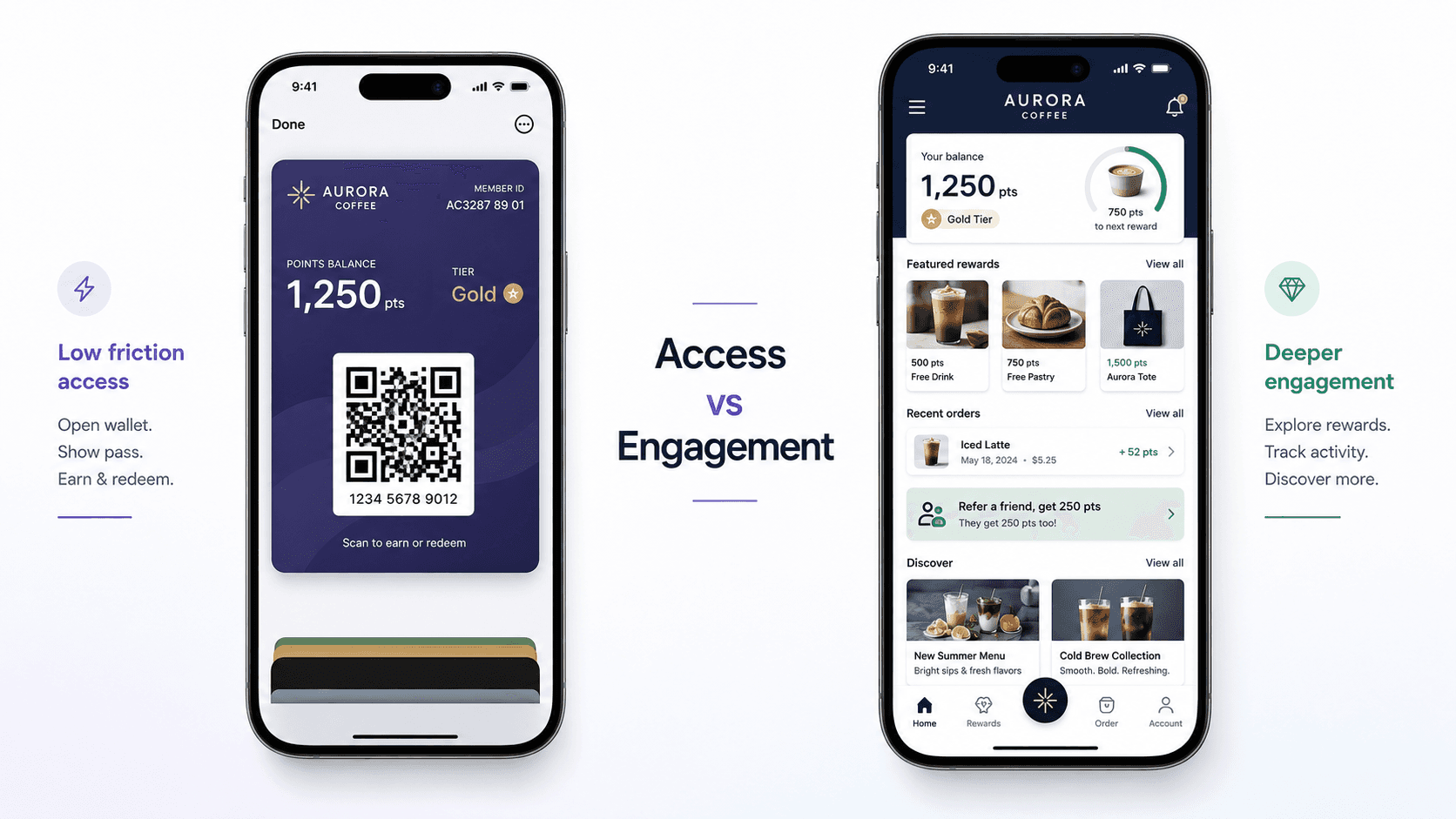
A mobile wallet loyalty pass is a digital card, coupon, membership credential, offer, or reward surface saved inside Apple Wallet or Google Wallet. It can show a member ID, barcode, QR code, points balance, tier status, offer, or account link depending on how it is built.
A loyalty app is a brand-owned mobile application where customers can manage more of the loyalty relationship. It can include rewards browsing, order history, product recommendations, referrals, missions, account settings, push messages, location features, content, and commerce.
The simple distinction:
Option | Main Job | Best Fit |
|---|---|---|
Mobile wallet pass | Make loyalty easy to access and present | Scan-to-earn, basic member recognition, digital card replacement, lightweight reminders |
Loyalty app | Create a richer owned customer experience | Product discovery, gamification, account management, referrals, content, deep personalization |
Loyalty platform | Run the business logic behind either experience | Identity, points, tiers, rewards, consent, segments, campaigns, analytics |
Apple Wallet supports rewards cards, gift cards, coupons, tickets, and other passes, and can present relevant passes based on time or location. Google Wallet documents loyalty cards that help customers access and redeem rewards, with issuance across Android apps, web, email, and SMS.
Those are strong access layers. They are not the whole loyalty program.
For a deeper implementation guide, see the CXForge article on running a mobile wallet loyalty program with Apple Wallet and Google Wallet.
When a Mobile Wallet Loyalty Pass Is the Better Choice
A wallet pass is usually the better starting point when the main problem is adoption.
Many customers do not want another app. They may join a program in store, from a QR code, through ecommerce checkout, or from a post-purchase email. If the next step is "download our app," a meaningful share of customers will drop off. If the next step is "add this card to your wallet," the experience can feel lighter.
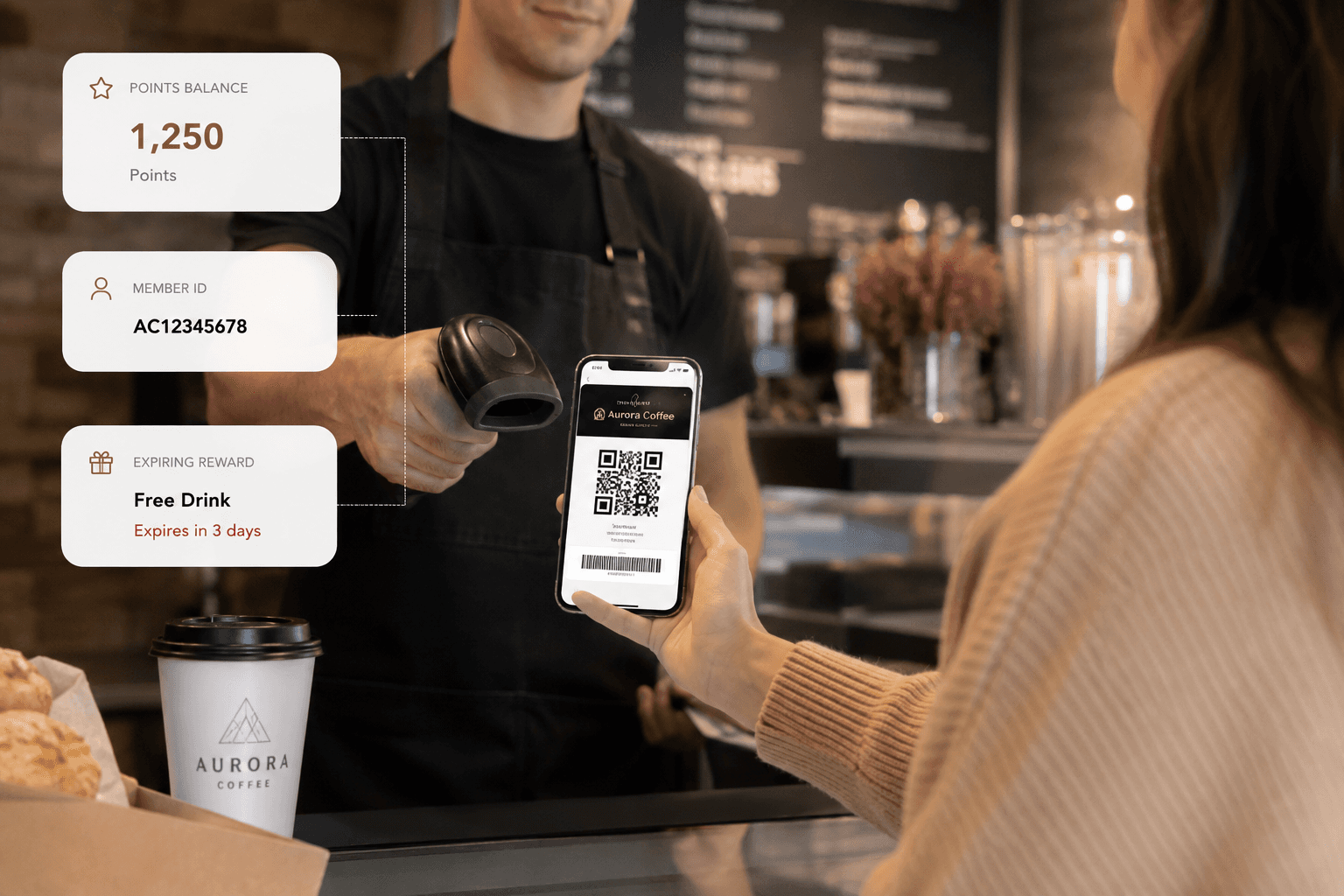
Wallet passes work especially well when:
the loyalty program needs fast in-store identification
customers frequently forget plastic cards or membership numbers
the brand wants a digital card without building a full app
the program has simple points, stamps, tiers, or offer visibility
the business has many casual members who will not install a dedicated app
store staff need a barcode, QR code, or member ID at checkout
the brand wants to reduce enrollment and redemption friction
For a cafe chain, the pass might show a scan code, visit progress, and an expiring reward. For a fashion retailer, it might show membership status and make in-store recognition easier. For a hotel, salon, grocery, or regional retailer, it can become the fastest bridge between offline visits and a unified customer profile.
The main advantage is convenience. The customer does not need to remember another login or open a brand app every time they shop.
Where Wallet Passes Are Limited
A wallet pass is compact by design. That is why it works, but it also creates limits.
Wallet passes are usually weaker for:
full reward catalog browsing
complex redemption journeys
gamified challenges and missions
product discovery and recommendations
personalized content
community features
advanced account management
returns, service, bookings, or order tracking
multi-step preference centers
detailed loyalty education
A wallet pass can point customers to these experiences, but it should not try to contain all of them. If the loyalty program requires a deep customer journey, the brand may need an app, account portal, or mobile web experience alongside the pass.
The other limitation is data. A wallet pass can display a balance, but it should not be the source of truth for that balance. A wallet pass can show a tier, but it should not calculate tier qualification. A wallet pass can include a barcode, but the POS and loyalty system still need to resolve that barcode to the right member.
This is where brands get into trouble. They launch a digital card and call it a loyalty program, but the card is not connected cleanly to POS, ecommerce, CRM, campaign tools, or analytics. The pass looks modern, while the operating model remains fragmented.
When a Loyalty App Is the Better Choice
A loyalty app is worth considering when the loyalty program needs more than access.
Apps make sense when the brand has enough customer frequency, value, or engagement depth to justify the install. That usually means the app is not only a card. It is useful on its own.
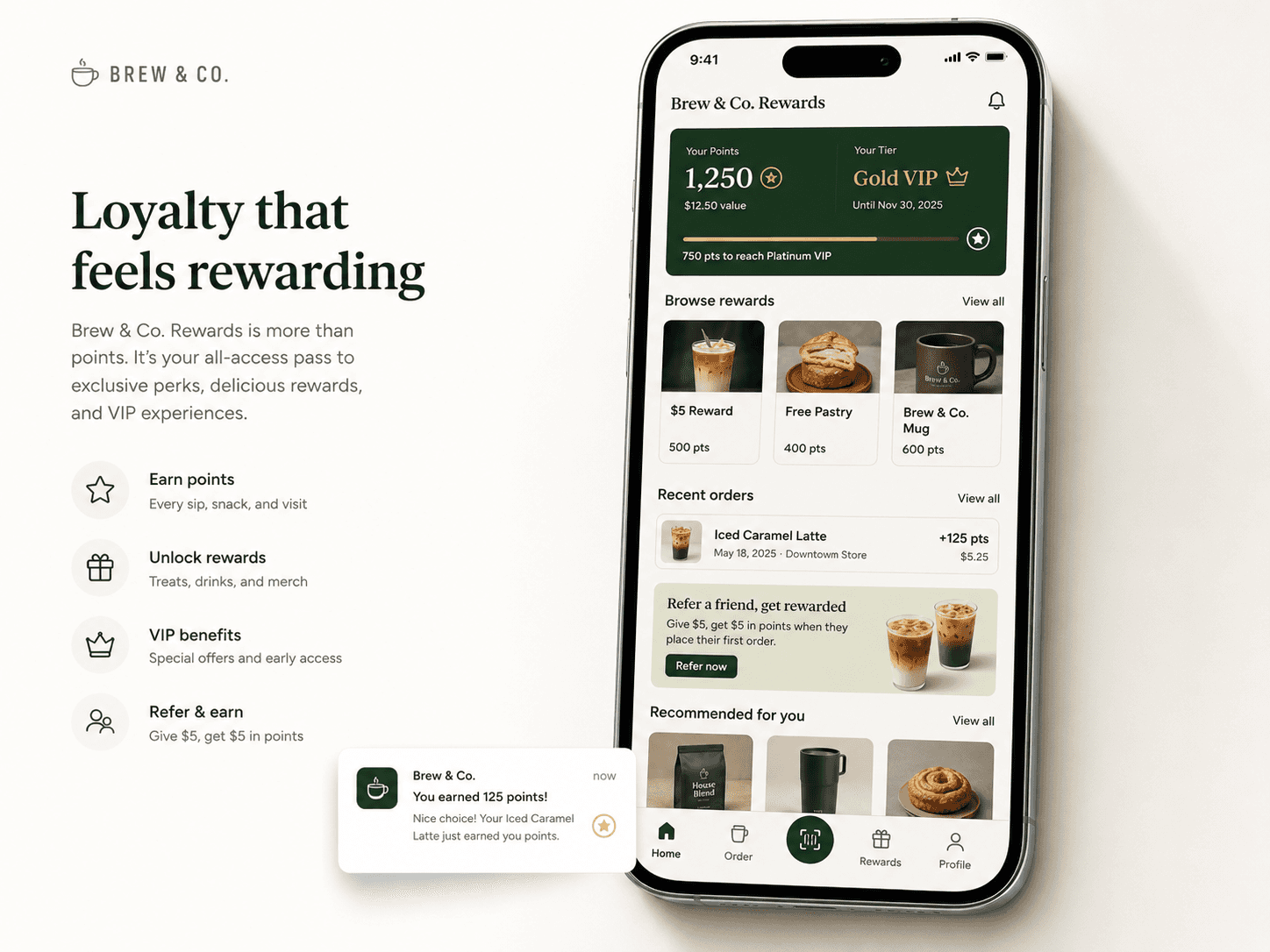
A loyalty app may be the better choice when:
customers shop frequently enough to open the app repeatedly
the brand needs product discovery, wishlists, drops, bookings, ordering, or service features
rewards require browsing, choosing, reserving, or combining benefits
the program uses challenges, missions, referrals, or gamification
the brand wants richer push notification journeys
customers need account management, preferences, support, or order history
the app also supports commerce, pickup, reservations, payments, or subscriptions
For a fashion brand, an app might support new-drop access, saved sizes, in-store availability, style preferences, VIP events, returns, and member-only campaigns. For F&B, it might support ordering, pickup, wallet balance, menu personalization, and visit-based offers. For hospitality, it might support booking management, stay preferences, upgrades, and service requests.
The app earns its place when it solves a repeated customer problem beyond "show my loyalty ID."
Where Loyalty Apps Become Expensive
The visible cost of a loyalty app is development. The hidden cost is keeping the app valuable enough to retain users.
Apps can fail when:
the only reason to install is a barcode
app onboarding creates more friction than the loyalty value is worth
push notifications become generic promo blasts
the reward catalog is stale
the app does not connect to store activity
the brand cannot maintain content, campaigns, and product surfaces
customer profiles in the app are disconnected from POS or ecommerce records
A weak app can make loyalty feel heavier than it needs to be.
This does not mean brands should avoid apps. It means the app needs a clear job. If the app is mainly a digital card, a mobile wallet pass may be the more pragmatic first move. If the app is a meaningful customer utility, it can become a stronger retention surface than a wallet pass alone.
Mobile Wallet vs Loyalty App: Cost Comparison
Cost is broader than build price. The right comparison includes implementation, adoption, operations, and ongoing optimization.
Cost Area | Mobile Wallet Pass | Loyalty App |
|---|---|---|
Build complexity | Lower for simple cards and offers; higher if pass updates, POS integration, and personalization are required | Higher, especially for native iOS/Android development, QA, releases, and feature depth |
Customer adoption | Usually easier because customers do not need a dedicated app | Harder because customers must install, onboard, and keep the app |
Maintenance | Pass templates, certificates, issuer setup, integrations, update logic, and compliance checks | App releases, OS updates, performance, bug fixes, app store management, SDKs, analytics, content |
Campaign operations | Good for focused updates and reminders | Stronger for rich campaigns, but needs more planning and creative upkeep |
Data requirements | Needs identity, pass ID mapping, loyalty ledger, update triggers, and consent | Needs the same, plus app events, push tokens, preferences, commerce or content behavior |
Support burden | Lower if the pass is simple; higher if balances drift or scans fail | Higher if login, device, update, notification, and feature issues occur |
Retention upside | Strong for recognition and access | Strong for deep engagement when customers have a reason to return |
The lowest-cost route is not always the cheapest route over time. A disconnected wallet pass can create reconciliation and support costs. A loyalty app nobody uses wastes build budget. The winning option is the one that matches actual customer behavior and is connected to the right data infrastructure.
For measurement planning, use the CXForge loyalty program ROI calculator guide before comparing channel cost alone.
Mobile Wallet vs Loyalty App: Adoption Tradeoffs
Wallet passes reduce the first barrier. Apps can increase the long-term surface area.
That difference matters.
A wallet pass can be distributed through channels customers already use: website, ecommerce account, email, SMS, QR code, or in-app flow. Apple documents pass distribution through an app, email, or the web. Google documents issuing passes through Android apps and anywhere hyperlinks are supported, including websites, email, and SMS.
This makes wallet passes practical for enrollment moments:
after ecommerce checkout
at POS from a QR code
inside a welcome email
from SMS after signup
from a member account page
after customer support enrolls a member
A loyalty app has a harder adoption path. The user must decide that the app is worth storage space, attention, notifications, and login effort. That can work, but it usually requires a stronger value proposition.
For many brands, wallet passes are better for broad member coverage. Apps are better for engaged members.
Retention Tradeoffs: What Actually Keeps Customers Coming Back?
A wallet pass improves retention indirectly by making identification and reward use easier. If customers can scan more reliably, see value more clearly, and redeem without friction, the program has a better chance of influencing behavior.
But wallet passes rarely create deep engagement by themselves. They are utility surfaces.
A loyalty app can create stronger retention when it becomes part of the customer routine. The app can show progress, recommend products, manage rewards, surface exclusive access, run challenges, support reorder behavior, and personalize the journey.
The tradeoff is that an app must earn repeat attention. If customers only open it when forced, it is not a retention engine. It is a heavier wallet card.
Use this practical rule:
Choose a wallet pass when the program needs easier access.
Choose an app when the customer needs a richer recurring experience.
Use both when broad access and deeper engagement are both important.
The Best Model for Many Brands: Wallet First, App Later
For mid-market retail, F&B, hospitality, and DTC brands, a phased model often makes the most sense.
Start with a wallet pass when the priority is to:
digitize the loyalty card
improve store recognition
reduce plastic cards
connect offline and online profiles
make rewards easier to access
learn which customers engage with mobile loyalty
Then add an app or richer account portal when the business has a clear reason:
enough loyalty members to justify deeper investment
strong repeat purchase frequency
product or menu discovery opportunities
VIP access or community features
personalized shopping journeys
order, booking, pickup, or service utility
enough campaign capacity to keep the experience fresh
The wallet-first approach avoids overbuilding. It also gives the brand data: who saves the pass, who scans, who redeems, who returns, and which segments need a richer experience.
What Needs to Sit Behind Both Options
Whether a brand chooses wallet, app, or both, the backend requirements are similar.
1. Unified Customer Identity
The system needs to recognize the same customer across POS, ecommerce, wallet pass, app, email, SMS, and support. Otherwise, loyalty activity fragments into disconnected records.
For more context, see the CXForge guide to omnichannel loyalty programs.
2. Loyalty Ledger
Points, tiers, stamps, rewards, expiry, adjustments, refunds, and reversals need a reliable ledger. The wallet pass or app should display this data, not invent it.
3. Integration with POS and Ecommerce
The program needs a way to identify members at checkout and connect activity back to the same profile. For wallet passes, that may mean barcode, QR code, NFC-supported flows, account lookup, or member ID mapping. For apps, it may mean scan, login, payment, order, or app event integrations.
4. Segmentation
A saved pass holder is not the same as an app power user. A points-rich non-redeemer is not the same as a lapsed member. The platform should segment based on real behavior and trigger different journeys.
Useful segments include:
pass saved, no first scan
app installed, no second session
first purchase, no loyalty redemption
points-rich customer near reward threshold
VIP app user with declining frequency
store-only wallet user
ecommerce-only app user
tier-near member
reward expired without use
For segmentation examples, see the CXForge article on customer segmentation for loyalty programs.
5. Campaign Orchestration
Wallet updates, push notifications, email, SMS, app messages, and onsite prompts should work from one customer strategy. If each channel runs separately, the customer receives inconsistent messages.
6. Consent and Preference Management
Wallet passes and apps are not shortcuts around consent. Customer permissions, suppression rules, and preference changes still need to be respected across channels.
7. Analytics
The brand should know whether the mobile experience changes behavior. Track adoption, scans, redemptions, repeat purchase, app engagement, reward liability, campaign performance, and incremental retention.
This is why the customer data layer matters. See the CXForge guide to using a data platform for loyalty marketing.
Decision Framework: Wallet, App, or Both?
Use this decision table before investing.
Business Situation | Better Starting Point |
|---|---|
Customers need a simple digital card for scanning | Mobile wallet pass |
The brand wants to replace plastic cards quickly | Mobile wallet pass |
Store staff need faster member lookup | Mobile wallet pass |
Customers shop frequently and need order, booking, or service features | Loyalty app |
The brand wants product discovery, wishlists, or member commerce | Loyalty app |
The program uses missions, referrals, or complex gamification | Loyalty app |
The brand has broad casual membership plus a smaller engaged VIP group | Both |
The brand has no customer data foundation | Fix the loyalty data layer first |
The program has disconnected POS and ecommerce identity | Fix recognition before expanding channels |
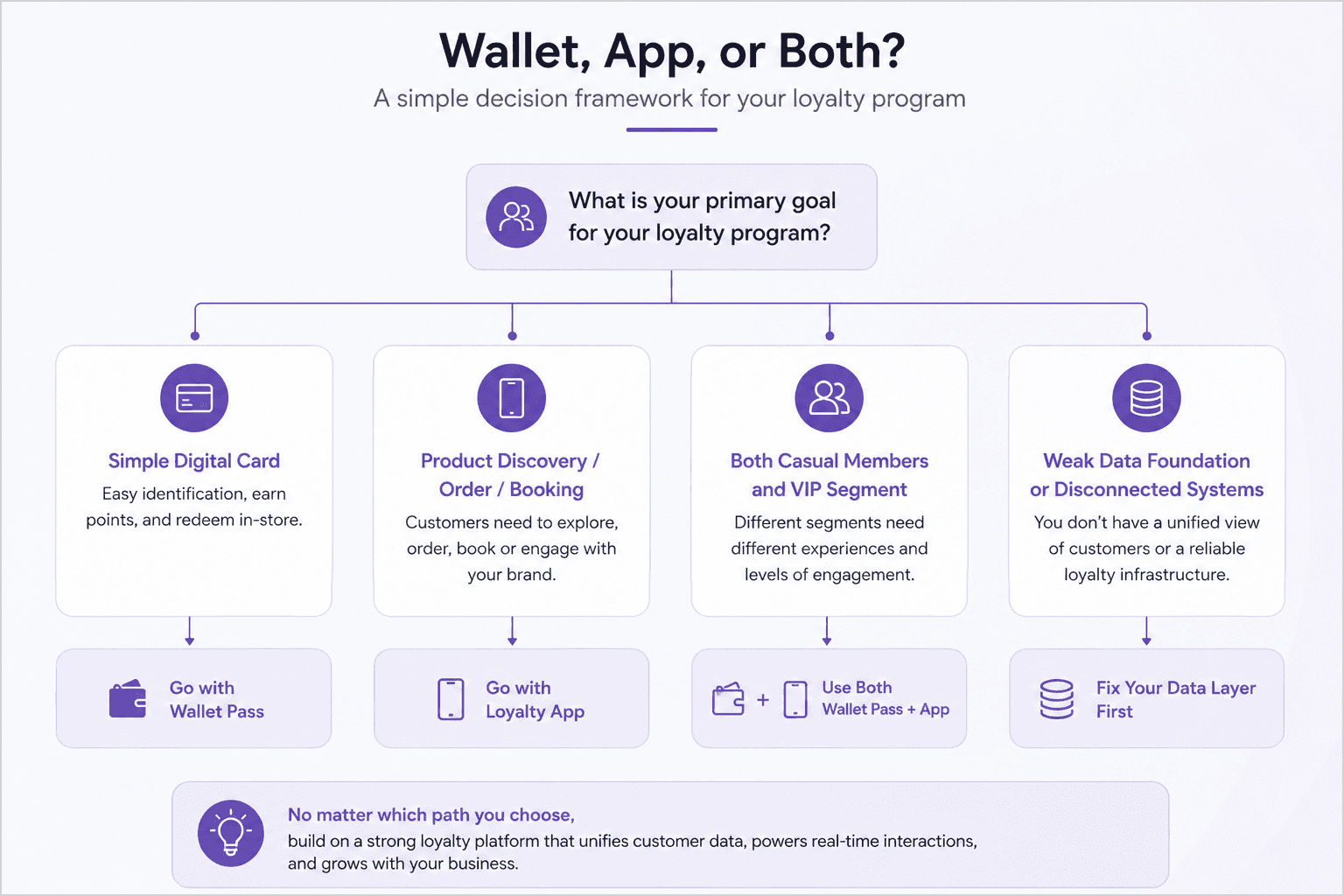
For CXForge buyers, the most important line is often the last one. If the loyalty data layer is weak, the channel choice will not solve the real problem.
How CXForge Supports Either Route
CXForge is positioned as the loyalty and customer data platform behind the customer-facing experience.
That means CXForge can support a wallet or app strategy by helping teams define and manage:
member identity and profile unification
points, rewards, tiers, and earn/burn rules
customer segments and lifecycle triggers
POS, ecommerce, CRM, and campaign connections
reward eligibility and offer governance
loyalty analytics and performance reporting
omnichannel recognition across store and digital behavior
The customer may see a wallet pass, an app, an email, an SMS, or an account page. The operator needs one coherent system behind those surfaces.
That is the practical test: does the mobile experience make loyalty easier for the customer and more measurable for the business?
Common Mistakes to Avoid
Treating a Wallet Pass as the Whole Program
A pass can display loyalty value. It does not replace reward logic, identity resolution, campaign decisions, or reporting.
Building an App When a Wallet Pass Would Solve the Real Problem
If the customer only needs a scannable card, a full app may add unnecessary cost and adoption friction.
Using Wallet Passes Without POS Readiness
If store teams cannot scan, recognize, or troubleshoot the pass, the customer experience breaks at the most important moment.
Sending the Same Campaigns to Pass Holders and App Users
These audiences behave differently. Segment them based on adoption, usage, purchase history, reward status, and channel preference.
Measuring Installs Instead of Behavior
Wallet saves and app installs are not enough. Measure identified transactions, repeat purchase, redemption rate, second-visit lift, tier progression, and lifecycle movement.
FAQ
Is a mobile wallet pass the same as a loyalty app?
No. A mobile wallet pass is a lightweight digital card or pass saved in Apple Wallet or Google Wallet. A loyalty app is a brand-owned mobile app with richer features such as account management, reward browsing, gamification, product discovery, and push journeys.
Do brands need a loyalty app if they support Apple Wallet or Google Wallet?
Not always. If the main need is a scannable member card, basic reward visibility, or easier store recognition, a wallet pass may be enough. If customers need richer engagement, account controls, ordering, referrals, or personalized product discovery, a loyalty app or account portal may still be useful.
Which is cheaper: mobile wallet loyalty or a loyalty app?
A wallet pass is usually cheaper and faster to launch than a full native app, but the total cost depends on integrations, pass updates, POS recognition, customer support, and data quality. A disconnected wallet pass can still become expensive if balances, scans, or customer records do not work properly.
Can a mobile wallet pass show points or tier status?
Yes, wallet passes can show loyalty information such as member IDs, barcodes, points, balances, offers, or tier status when implemented correctly. The loyalty platform should remain the source of truth and update the pass when customer status changes.
When should a brand build a loyalty app?
A brand should consider a loyalty app when customers have a repeated reason to use it: ordering, booking, product discovery, wishlists, VIP access, reward catalogs, challenges, referrals, account management, or personalized experiences that go beyond a simple digital card.
What is the best approach for retail and F&B brands?
Many retail and F&B brands should start with a wallet pass for fast adoption and in-store recognition, then add a richer app or account portal only when the customer experience needs deeper engagement. The loyalty platform and customer data layer should support either route.