Build a Multi-Partner Loyalty Rewards Ecosystem
Updated on:

A multi partner loyalty program gives customers one loyalty experience that works across more than one brand. A member might earn points from a supermarket, redeem with a fuel partner, unlock a restaurant perk, receive a hotel offer, or link a payment card for automatic recognition across the network.
That sounds simple from the customer's side. Behind the scenes, it is one of the more complex loyalty models to operate.
Each partner brings its own margins, data systems, customer base, promotion calendar, legal constraints, and commercial objectives. The program has to decide who owns the member relationship, how points or benefits are funded, how customer data is shared, how partners settle value between one another, and how the experience stays simple enough for members to use.
This guide explains how multi-partner loyalty programs work, when they make sense, which operating models to consider, and what technology and governance a brand needs before launching a shared rewards ecosystem.
Key Findings
A multi partner loyalty program is not just a bigger rewards catalog. It is a shared operating model across customer identity, rewards rules, data permissions, partner economics, and member experience.
The strongest partner networks are built around real customer journeys: travel, retail, F&B, hospitality, fuel, financial services, malls, lifestyle groups, and regional ecosystems.
A coalition loyalty program is one version of a multi-partner model, but brands can also launch lighter partner earn, cross-brand redemption, marketplace, group-owned, or regional partner loyalty solutions.
Governance matters as much as technology. Partners need clear rules for data use, offer approvals, liability, reconciliation, fraud handling, customer support, and exit rights.
Customer data is the long-term advantage. The program should help partners understand behavior across the ecosystem without violating consent, privacy, or commercial boundaries.
CXForge is a natural fit when the program needs loyalty logic, unified customer profiles, segmentation, lifecycle campaigns, and measurement working together.
What Is a Multi Partner Loyalty Program?
A multi partner loyalty program is a loyalty model where customers can earn, redeem, or receive benefits across a network of participating brands.
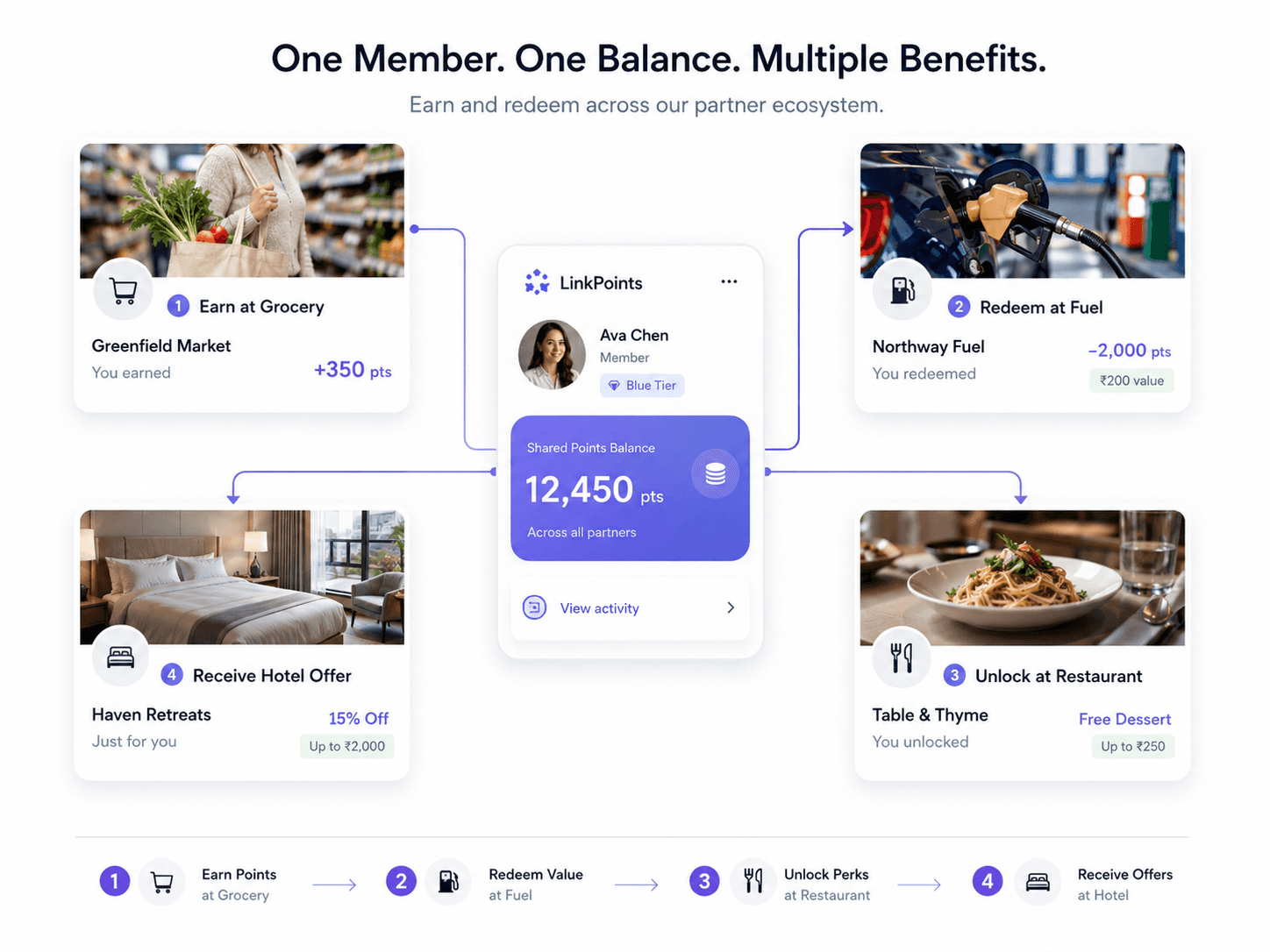
In a single-brand program, the customer earns and redeems value mainly inside one brand. In a multi-partner program, the loyalty experience expands across an ecosystem. The network may use one shared currency, linked accounts, card-linked offers, partner coupons, tier recognition, transfer rules, or cross-brand reward catalogs.
Common models include:
Model | How it works | Best fit |
|---|---|---|
Coalition loyalty program | Multiple brands share one loyalty currency or membership experience | Grocery, fuel, banking, travel, entertainment, regional ecosystems |
Group-owned multi-brand program | One parent company connects several owned brands under one member profile | Hospitality groups, restaurant groups, retail groups, malls, franchise groups |
Partner earn network | Customers earn points or benefits with selected external partners | Airlines, hotels, banks, fintech apps, marketplaces |
Partner redemption marketplace | Customers redeem points for rewards, vouchers, travel, experiences, or partner products | Programs that need broader reward utility without full coalition complexity |
Linked loyalty program | Customers connect accounts across brands or platforms to unlock shared benefits | Travel, payments, ecommerce, subscriptions, memberships |
Regional partner loyalty solution | Local businesses, destinations, tourism operators, malls, or city ecosystems share loyalty infrastructure | Regional retail, tourism boards, destination marketing, hospitality clusters |
The right model depends on whether the business wants a full shared loyalty currency, a lighter partner-benefit layer, or a controlled ecosystem that connects owned and partner brands.
Multi-Partner Loyalty vs Coalition Loyalty Programs
A coalition loyalty program is a type of multi-partner loyalty program, but the terms are not always identical.
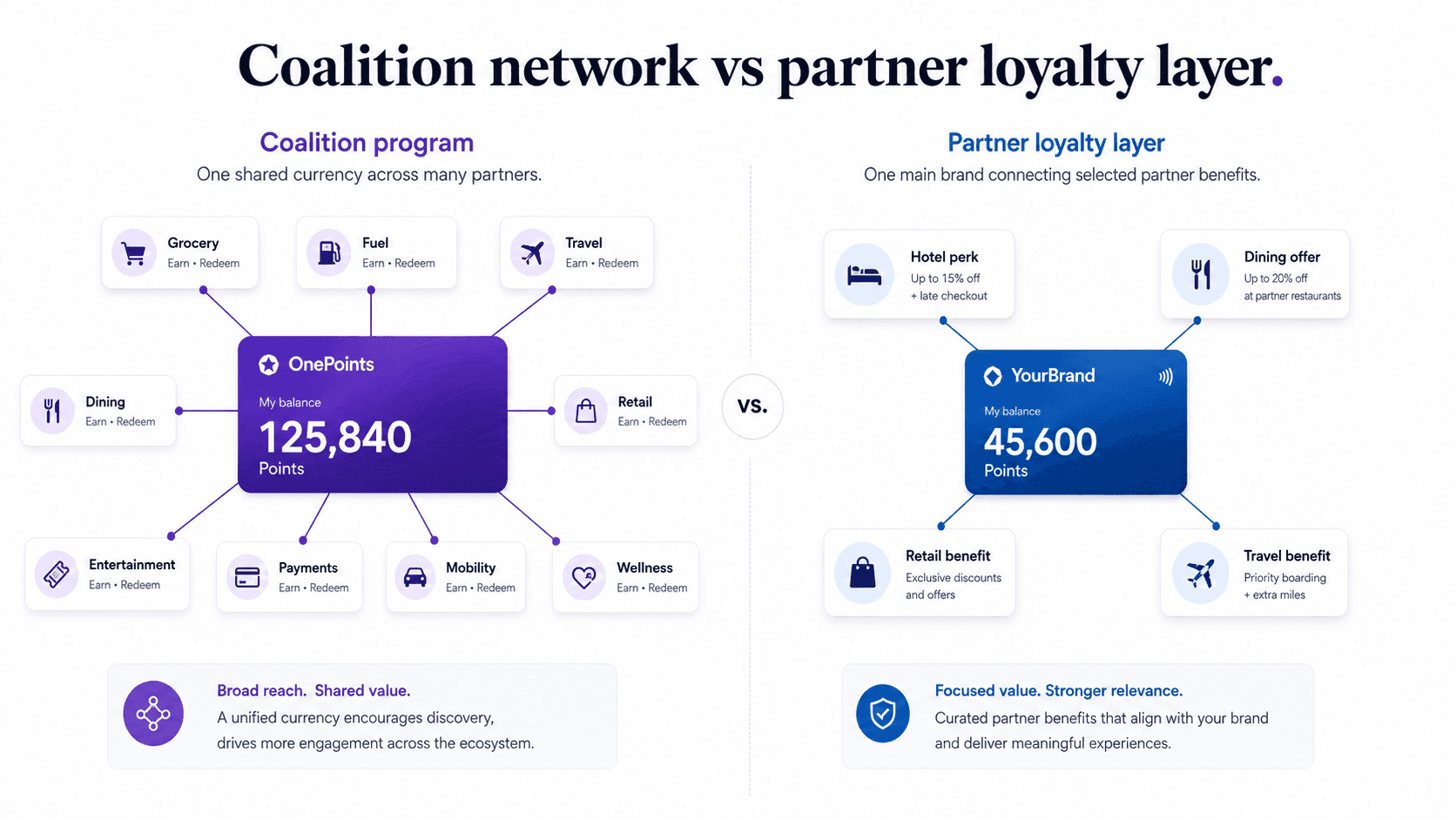
Coalition loyalty programs usually involve a broad partner network, a recognizable shared currency or membership brand, and centralized rules for earning and redemption. The customer thinks of the program as an ecosystem, not just a feature inside one brand.
A multi partner loyalty program can be broader or lighter. It might be a retail group connecting fashion, beauty, and homeware brands. It might be a travel company connecting hotels, restaurants, tours, and transport. It might be a payment app rewarding spend across merchants. It might be a regional mall program that gives shoppers one profile and reward experience across tenants.
The practical distinction is this:
Use a coalition model when the loyalty brand, currency, and partner network are central to the customer proposition.
Use a multi-partner model when partner recognition and shared rewards support the main brand experience without requiring a full standalone coalition.
For example-led coverage, pair this guide with CXForge's article on best coalition loyalty programs.
When Does a Multi Partner Loyalty Program Make Sense?
Multi-partner loyalty works best when the partner network makes the customer experience more useful, not just more complicated.
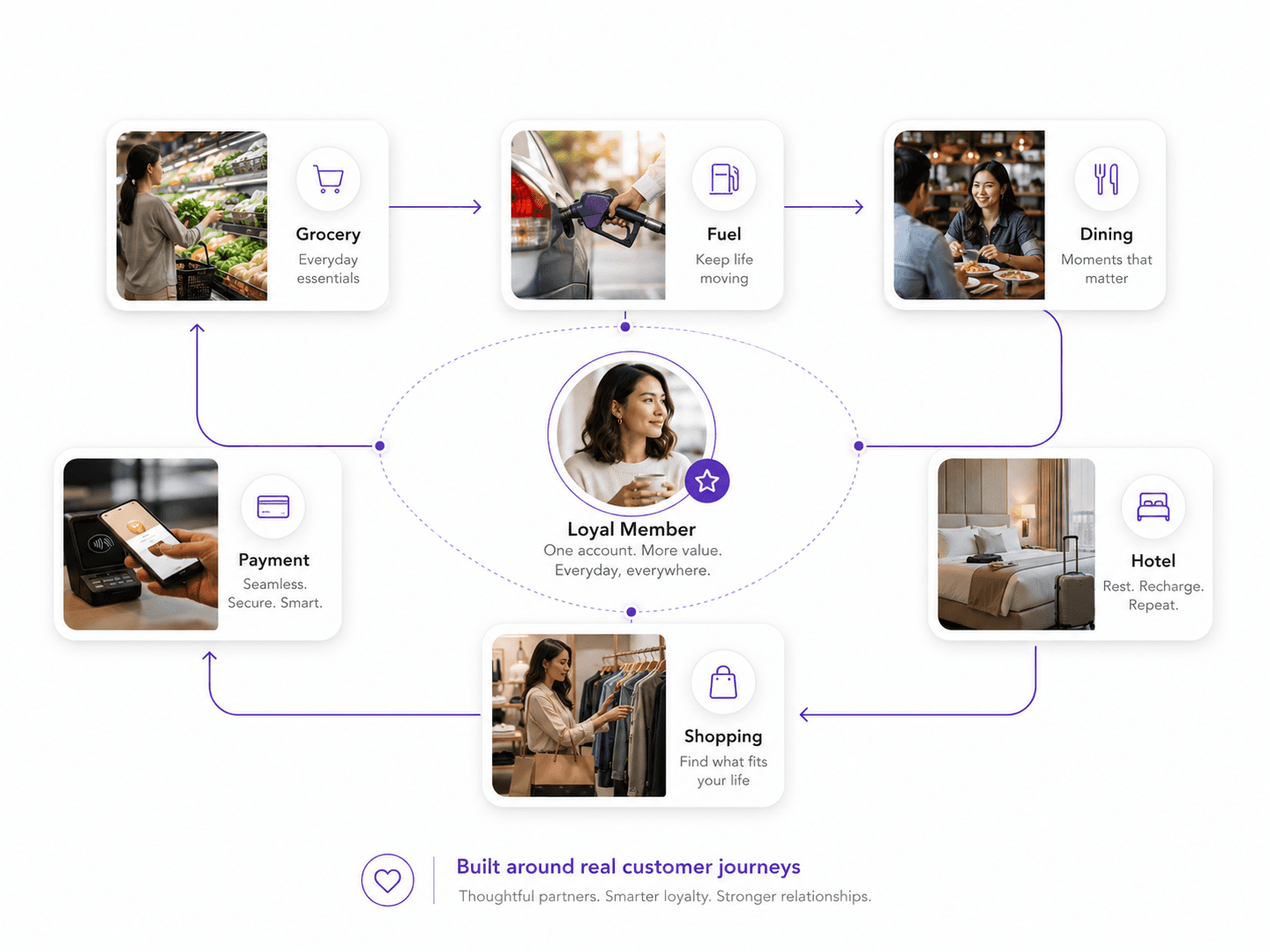
It can make sense when:
Customers naturally move across the partner set in one journey, such as flights, hotels, restaurants, transport, retail, and experiences.
One brand has high customer frequency while another has high reward aspiration, such as grocery earn and travel redemption.
A parent company owns several consumer brands and wants one customer view across the group.
A mall, destination, city, or regional ecosystem wants to increase repeat visits and partner participation.
A payment, wallet, fintech, or marketplace platform can recognize spend across many merchants.
Partners have complementary audiences and want shared acquisition, retention, or reactivation campaigns.
The reward value becomes more meaningful when customers can earn faster or redeem across more options.
It is usually a poor fit when partners have weak customer overlap, unclear data permissions, low redemption value, thin margins, or no willingness to fund rewards and operations. A long partner list does not create loyalty by itself. The program needs a clear reason for members to care and a clear business reason for partners to participate.
The Five Operating Models to Consider
1. Shared Points Currency
This is the most recognizable model. Members earn one points currency across multiple brands and redeem it across approved options.
The benefit is simplicity for the customer. The challenge is operating discipline. The program needs currency valuation, liability management, earn and burn controls, fraud monitoring, partner settlement, expiry rules, and consistent customer support.
Shared currency works best when the network can create frequent earning and desirable redemption. Grocery, fuel, banking, travel, and entertainment often play strong roles because they combine routine behavior with visible value.
2. Earn Here, Redeem There
In this model, customers may earn with one group of partners and redeem with another. For example, everyday retail spend can fund travel, dining, vouchers, or experiences.
This can improve reward appeal because members are not limited to discounts from the same brand. It also lets lower-frequency partners participate as aspirational redemption options.
The risk is margin leakage. If redemption is too generous or settlement rules are unclear, the program can create cost without measurable retention. The platform must track who funded the points, where value was redeemed, and what business outcome followed.
3. Partner Benefits Without a Shared Currency
Not every multi-partner program needs points pooling across brands. Some ecosystems work through tier recognition, exclusive access, member-only offers, linked benefits, or campaign-based rewards.
This model is often easier to launch because it avoids some currency liability. It can work well for hospitality groups, restaurant groups, retail partnerships, subscription bundles, and destination programs.
The key is relevance. Partner benefits should feel connected to the customer's journey. Random voucher swaps usually underperform because customers do not understand why the partner is there.
4. Card-Linked or Receipt-Linked Rewards
Card-linked rewards use a customer's linked payment card to recognize qualifying spend at participating merchants. Receipt-linked rewards use uploaded or scanned receipts to validate partner purchases.
These models can reduce integration work for smaller merchants, which makes them useful for regional partner loyalty solutions, malls, tourism ecosystems, and merchant-funded offer networks.
The tradeoff is data quality and experience control. Payment or receipt signals may confirm spend, but they do not always capture item-level behavior, preferences, service context, or in-app engagement. The program still needs a customer data layer to turn transactions into useful segments and campaigns.
5. Group-Wide Loyalty Across Owned Brands
Multi-brand groups often do not need an external coalition. They need one loyalty architecture across several owned brands.
Examples include hotel groups, restaurant groups, apparel groups, beauty and wellness groups, grocery and convenience groups, and retail holding companies. The customer may see different brands, but the operator needs one view of identity, preferences, rewards, campaigns, consent, and lifetime value.
This model can be powerful because governance is easier than a true external partner network. The challenge is internal alignment: each brand may have different margins, calendars, audiences, and channel systems.
What Technology Does a Multi-Partner Loyalty Program Need?
A shared rewards ecosystem needs more than a points engine. The technology stack has to support loyalty operations, partner operations, customer data, campaign activation, and measurement.
At minimum, look for these layers.
Unified Customer Identity
The program needs to recognize members across partner touchpoints. That may include ecommerce accounts, app logins, POS identifiers, email, phone, loyalty ID, payment token, booking reference, or receipt data.
Identity resolution should support consent and privacy rules. Partners should not receive unrestricted access to every customer attribute. The platform needs permissioned views, role-based access, and clear data-sharing logic.
Flexible Earn and Redemption Rules
Each partner may need different rules:
Earn by spend, visit, booking, product category, fare class, room night, campaign, or bonus action.
Redeem for discounts, vouchers, points conversion, merchandise, travel, services, experiences, or partner benefits.
Apply exclusions, caps, minimum thresholds, blackout dates, fraud holds, expiry rules, and tier multipliers.
The platform should let operators configure these rules without custom engineering for every campaign.
Partner Ledger and Settlement
Settlement is where many multi-partner programs become operationally painful.
The program must know which partner issued value, which partner redeemed value, what the points or reward were worth, whether the transaction was reversed, and how the partner should be billed or credited.
A practical partner ledger should support:
Earn liability by partner.
Redemption cost attribution.
Breakage assumptions and expiry.
Reversals, refunds, and adjustments.
Partner invoices or reconciliation exports.
Audit trails for disputed transactions.
Without this layer, finance teams end up reconciling loyalty value manually.
Segmentation and Personalization
Multi-partner loyalty creates richer customer signals. A member may browse travel rewards, buy from grocery partners weekly, redeem with restaurants, and respond to fuel offers.
Those signals should feed segmentation:
New members who need a first earn action.
Active earners who have not redeemed.
High-value customers with low partner breadth.
Customers who shop one partner but match another partner's audience.
Lapsed members who can be reactivated with a nearby partner offer.
Households, travelers, or business buyers with shared behavior patterns.
This is where CXForge's loyalty plus customer data positioning matters. The program should not stop at recording transactions. It should help operators decide who to message, which offer to show, and whether the partner network is increasing retention.
For the data foundation behind this, see how data platforms transform loyalty marketing.
Campaign Orchestration
A multi-partner program needs campaign controls so offers do not collide.
For example, a restaurant partner may want a weekend reactivation offer, a retail partner may want a category bonus, and a hotel partner may want a stay-package promotion. The platform should manage audience eligibility, suppression rules, frequency caps, partner approvals, attribution windows, and post-campaign reporting.
Fraud and Abuse Controls
Shared rewards ecosystems create more attack surfaces than single-brand programs. Abuse can happen through fake accounts, linked account manipulation, refund loops, receipt fraud, unauthorized transfers, suspicious redemption velocity, or partner-channel gaps.
Fraud controls should include:
Account-linking verification.
Velocity and anomaly checks.
Redemption risk scoring.
Manual review workflows.
Partner-specific risk rules.
Audit logs for points adjustments.
Fraud prevention should be designed before launch, not added after the first high-value redemption incident.
Governance Rules Partners Should Agree Before Launch
The hardest parts of a multi partner loyalty program are often commercial and operational, not technical.
Before launch, partners should agree on:
Governance area | Questions to answer |
|---|---|
Member ownership | Who owns the member relationship and support responsibility? |
Data permissions | What data can each partner see, use, export, or activate? |
Currency economics | How are points valued, funded, expired, reversed, and reported? |
Offer approvals | Who approves partner campaigns, creative, eligibility, and exclusions? |
Settlement | How often are partners invoiced, credited, and reconciled? |
Service levels | Who handles missing points, refunds, abuse, outages, and disputes? |
Brand standards | How are partner offers presented in app, email, web, POS, and receipts? |
Exit rules | What happens if a partner leaves the program? |
These decisions should be documented in the program design, partner agreement, and platform configuration. If the business rules only live in meetings and spreadsheets, the program will become fragile as soon as more partners join.
How to Design the Member Experience
Members should not have to understand the operating model. They need a clear answer to four questions:
Where can I earn?
What do I get?
How do I redeem?
Why should I come back?
Good multi-partner programs make this simple through a few design choices.
Use one clear program promise. If the member has to read a long explanation before joining, the proposition is probably too complex.
Show partner relevance by journey, not by logo count. Travel, dining, fuel, shopping, entertainment, wellness, and financial services can be grouped around real use cases.
Make progress visible. Points balance, tier progress, next reward, expiring value, and partner offers should be easy to understand.
Reduce redemption friction. If members can earn everywhere but redeem almost nowhere, trust drops. Redemption should feel achievable and useful.
Personalize partner offers carefully. The goal is to make the network feel more relevant, not to flood every member with every partner promotion.
Metrics That Prove the Partner Network Is Working
Enrollment alone is not enough. A multi partner loyalty program should be measured by whether the ecosystem changes customer behavior and partner economics.
Track:
Active member rate.
Earn frequency by partner.
Redemption rate and time to first redemption.
Cross-partner activation rate.
Partner breadth per member.
Incremental visits, bookings, orders, or spend.
Repeat purchase or repeat booking rate.
Offer activation and campaign lift.
Reward cost as a share of incremental margin.
Liability, breakage, and expiry.
Fraud rate and manual adjustment volume.
Partner retention and partner campaign participation.
For regional partner loyalty solutions, also track local ecosystem health: participating merchants, active locations, repeat visits, customer overlap, destination-level engagement, and campaign participation by partner.
Common Mistakes to Avoid
Launching With Too Many Partners and No Clear Anchor
The program needs a high-frequency anchor or a highly desirable redemption anchor. Without one, customers may not earn fast enough or care enough to return.
Treating Partner Onboarding as a One-Time Setup
Each partner needs technical setup, offer rules, staff education, reporting, finance workflows, and support handling. Onboarding should be a repeatable process.
Sharing Too Much Data Too Quickly
Partners want insight, but unrestricted data sharing can create privacy risk and partner distrust. Use permissioned data views and aggregate reporting where appropriate.
Ignoring Settlement Until Finance Complains
Every earn, burn, refund, expiry, and adjustment has economic meaning. Build the ledger early.
Letting the Reward Catalog Replace Strategy
A bigger catalog is not the same as a stronger loyalty proposition. The program still needs segmentation, lifecycle journeys, customer insight, and clear value exchange.
CXForge Angle: Build the Loyalty Network Around Customer Data
The best multi-partner loyalty programs are not only reward programs. They are customer data systems with a loyalty experience on top.
CXForge is positioned for the operating layer where loyalty rules, customer profiles, segmentation, campaigns, and reporting need to work together. For a multi-partner program, that means helping operators:
Create unified member profiles across touchpoints.
Segment customers by partner behavior, lifecycle stage, value, and engagement.
Configure earn, redemption, tier, and offer rules.
Trigger personalized campaigns across email, SMS, app, web, and partner moments.
Measure whether partner activity improves retention and revenue.
Give teams a practical view of loyalty performance without relying on spreadsheet reconciliation.
The goal is not to build the biggest partner network possible. The goal is to build the partner network that makes customers more active, gives partners measurable value, and creates a data foundation the business can operate with confidence.
Launch Checklist for a Multi Partner Loyalty Program
Use this checklist before choosing technology or signing partner agreements:
Define the customer promise in one sentence.
Pick the anchor use case: everyday earn, aspirational redemption, regional visits, travel journey, owned-brand ecosystem, or merchant-funded offers.
Decide whether the program needs a shared currency, partner benefits, linked accounts, card-linked rewards, or a hybrid model.
Map the member identity fields needed across partners.
Define consent, privacy, and data-sharing rules.
Create earn, burn, expiry, reversal, and fraud rules.
Model points liability and partner settlement.
Build partner onboarding and support workflows.
Plan member lifecycle journeys from enrollment to first earn, first redemption, cross-partner activation, and reactivation.
Define reporting for partners, finance, marketing, and leadership.
Start with a focused partner set, prove behavior change, then expand.
FAQ
What is a multi partner loyalty program?
A multi partner loyalty program lets customers earn, redeem, or receive benefits across more than one participating brand. It may use a shared points currency, linked accounts, partner benefits, card-linked offers, or a group-wide member profile.
Is a multi partner loyalty program the same as a coalition loyalty program?
Not always. A coalition loyalty program is usually a broad shared rewards ecosystem with a common loyalty currency or membership brand. A multi partner loyalty program can also be a smaller partner network, an owned multi-brand program, a linked-account benefit, or a regional partner loyalty solution.
What are loyalty programs that pool points across brands?
Loyalty programs that pool points across brands allow members to combine value earned from multiple partners into one usable balance or shared reward experience. They need clear rules for earn value, redemption value, partner settlement, fraud controls, reversals, expiry, and customer support.
What technology is needed for a regional partner loyalty solution?
A regional partner loyalty solution needs member identity, partner onboarding, earn and redemption rules, customer consent controls, campaign tools, a partner ledger, settlement reporting, fraud monitoring, and analytics for merchants, operators, and regional sponsors.
Why do multi-partner loyalty programs fail?
They often fail because the partner mix is weak, the customer promise is unclear, redemption is too hard, data sharing is poorly governed, settlement is manual, or partners do not see measurable value from participation.
How should brands choose partners for a shared rewards ecosystem?
Choose partners around real customer journeys and complementary behavior. Strong partners add earn frequency, redemption appeal, local convenience, data insight, or lifecycle relevance. Avoid adding partners only to make the network look larger.