Travel Loyalty Platform Guide
Updated on:

Key findings
A travel loyalty platform should do more than issue points. It should connect traveler identity, rewards, tiers, partner activity, lifecycle campaigns, and retention analytics.
Travel loyalty software needs to support longer purchase cycles, multiple journey stages, family or group travel, and partner-heavy ecosystems.
A travel rewards platform becomes more valuable when it is connected to customer data, segmentation, and campaign orchestration.
Airlines, hotels, OTAs, and tourism brands need different loyalty mechanics, but they share the same foundation: a unified traveler profile and auditable rewards ledger.
Partner rewards can increase program utility, but they need clear rules for liability, earn and burn economics, consent, fraud controls, and reporting.
The best travel loyalty solution should be evaluated on repeat booking impact, direct booking growth, ancillary revenue, partner performance, and margin after rewards.
Article
A travel loyalty platform is the system that helps travel brands recognize travelers, reward valuable behavior, personalize journeys, and measure whether loyalty is actually increasing repeat bookings.
For airlines, hotels, OTAs, tourism groups, and travel marketplaces, loyalty is not just a points balance. The customer journey is longer, more emotional, and more partner-driven than most retail buying journeys. A traveler might search on mobile, book through an OTA, check in at a hotel, dine with a partner, redeem a benefit during the trip, and return months later for a different purpose.
If those moments sit in separate systems, the brand cannot build real loyalty. It can only run campaigns.
A modern travel loyalty platform should bring those pieces together: member identity, reward rules, tier status, partner activity, segmentation, offers, consent, and reporting. The goal is simple: turn one-time travel transactions into known customer relationships that are easier to retain, personalize, and grow.
What is a travel loyalty platform?
A travel loyalty platform is software that manages loyalty members, rewards, tiers, offers, customer data, and engagement journeys for travel businesses.
It is used by:
Travel business | Common loyalty goals |
|---|---|
Airlines | Frequent flyer engagement, miles, tiers, partner earning, ancillary revenue |
Hotels and resorts | Direct bookings, repeat stays, upgrades, guest recognition, property-level rewards |
OTAs and travel marketplaces | Repeat bookings, package cross-sell, member-only rates, customer retention |
Tourism operators | Repeat visits, bundled experiences, destination partnerships, referrals |
Travel groups | Shared customer identity across brands, cross-property loyalty, partner rewards |
The simplest travel rewards software might only track points and redemptions. A broader travel loyalty solution should also support traveler profiles, lifecycle campaigns, segmentation, partner rules, analytics, and integrations with booking or CRM systems.
That difference matters. Points can create a reason to come back. Customer data and journey orchestration create the timing, relevance, and measurement needed to make that return more likely.
Why travel loyalty is different from retail loyalty
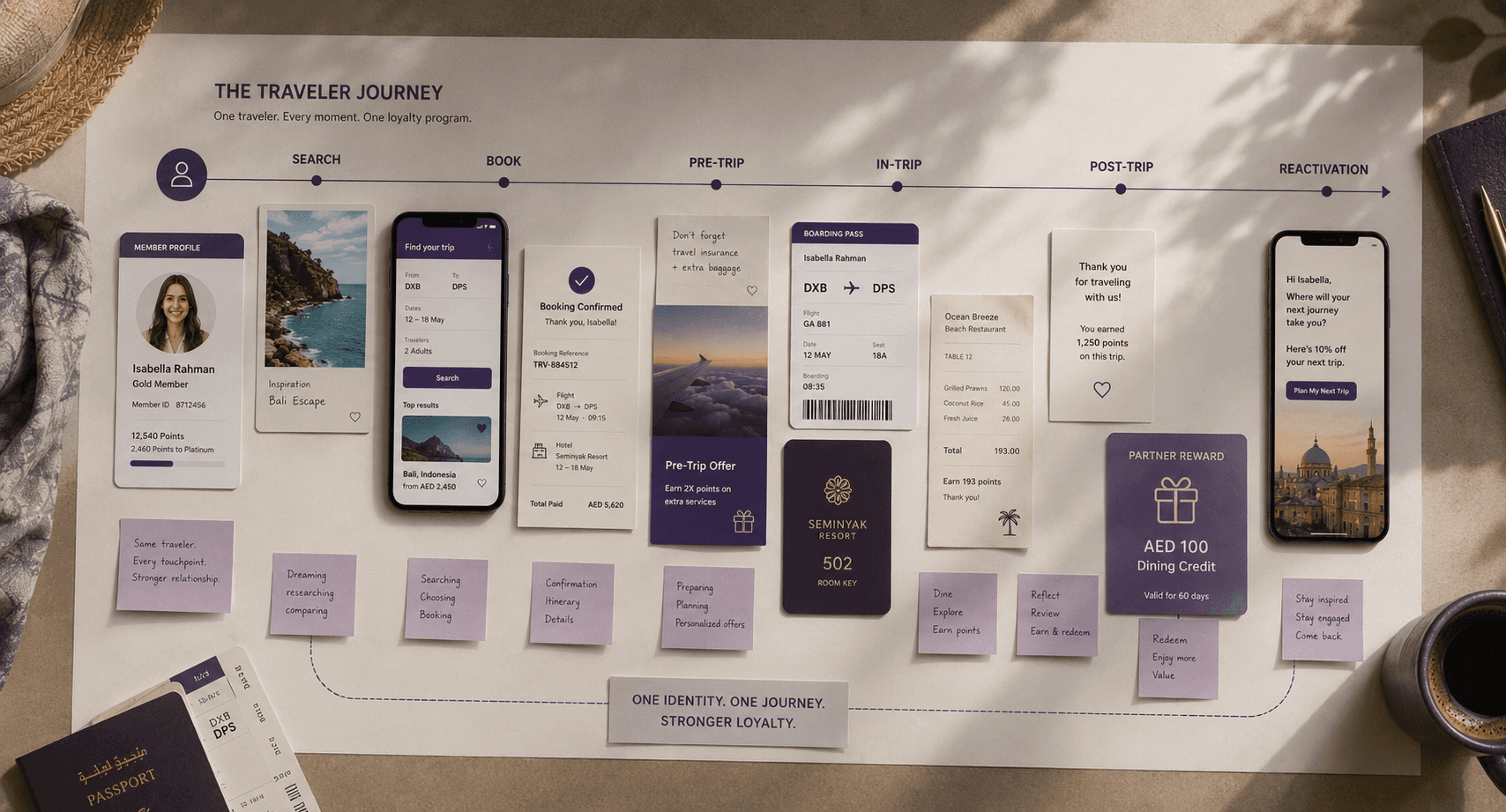
Travel loyalty has different operating conditions from everyday retail or ecommerce loyalty.
Retail programs often depend on frequent transactions. Travel programs usually deal with lower frequency, higher consideration, higher ticket sizes, and more complex journeys. The member may not book every week, but each trip can involve flights, rooms, upgrades, dining, insurance, transfers, tours, events, and partner redemptions.
That changes the loyalty design.
Loyalty design area | Retail pattern | Travel pattern |
|---|---|---|
Purchase frequency | Often high | Often seasonal or occasional |
Decision unit | Individual or household | Individual, family, group, corporate, or agent-assisted |
Reward value | Discounts, cashback, perks | Points, miles, status, upgrades, access, partner benefits |
Journey stages | Browse, buy, return | Search, book, pre-trip, in-trip, post-trip, reactivation |
Partner role | Optional | Often central |
Data challenge | Omnichannel purchases | Identity across booking, stay, travel, partner, and service moments |
A strong travel loyalty platform respects those differences. It does not treat every traveler like a shopper waiting for a coupon. It recognizes the timing, purpose, and context of each trip.
Core capabilities every travel loyalty platform should include
When evaluating travel loyalty software, start with capabilities that support both customer experience and operational control.
Capability | Why it matters |
|---|---|
Unified traveler profile | Connects booking, spend, preferences, consent, rewards, and engagement history |
Rewards ledger | Tracks earn, burn, expiry, refunds, adjustments, transfers, and partner activity |
Tier management | Supports status levels, qualification rules, soft landings, grace periods, and benefits |
Segmentation | Separates business travelers, leisure travelers, families, VIPs, lapsed members, and high-intent bookers |
Lifecycle journeys | Automates pre-trip, in-trip, post-trip, winback, near-expiry, and next-trip campaigns |
Partner rules | Defines earn and redeem logic across airlines, hotels, restaurants, attractions, and other partners |
Offer management | Controls targeted promotions, member rates, bonus points, bundles, and upgrade offers |
Consent and preference management | Supports permission-based personalization and compliant messaging |
Analytics | Measures repeat booking, direct booking share, redemption behavior, breakage, liability, and ROI |
Integrations | Connects with booking engines, CRM, PMS, ecommerce, messaging, payment, and analytics tools |
The most important question is not whether the platform has a points engine. It is whether the platform can use traveler data to make rewards and communications more relevant over time.
The traveler profile is the foundation
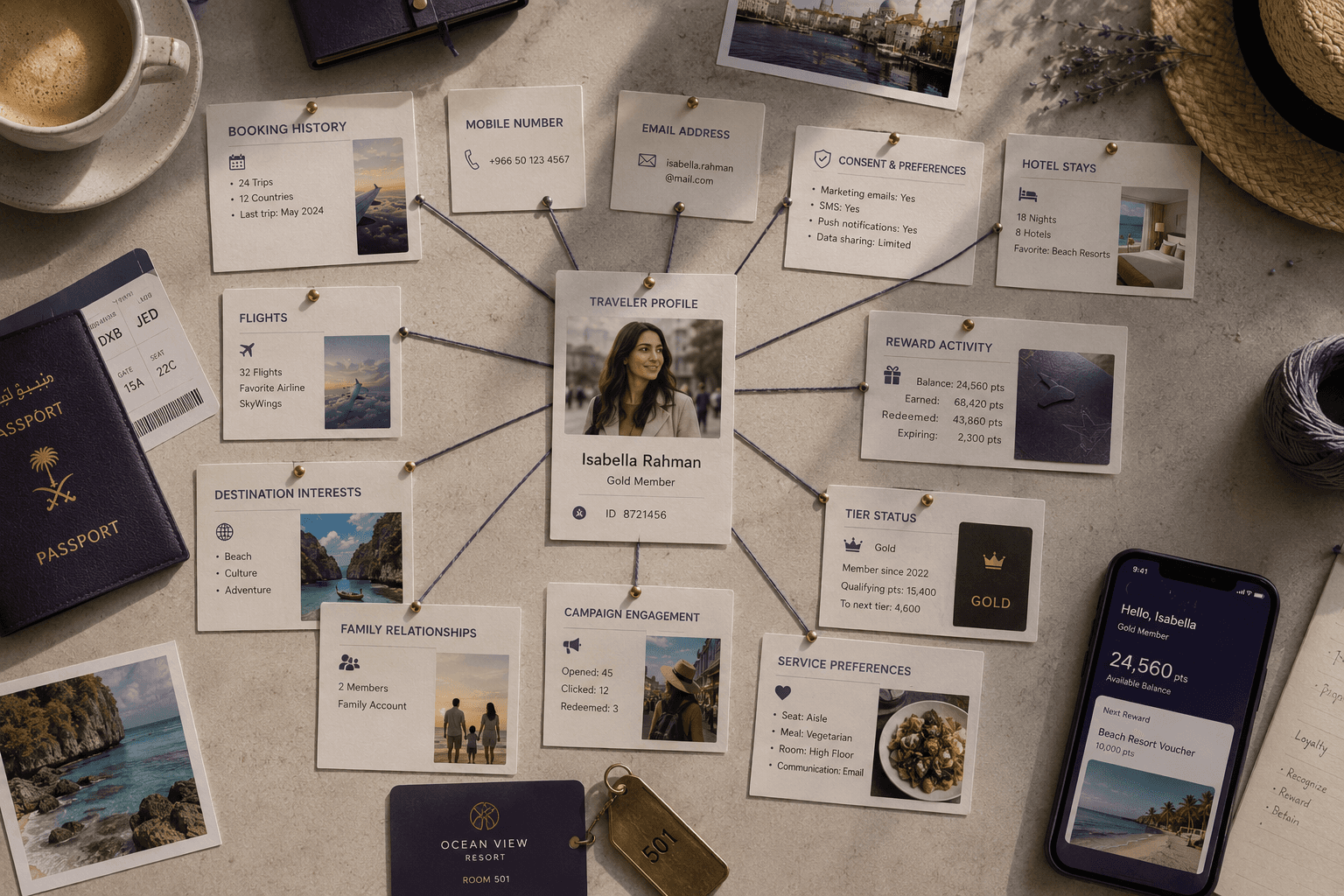
Many travel brands struggle with fragmented identity.
One traveler may book with an email address, check in with a phone number, join loyalty through a social login, redeem with a partner, and contact support through another channel. If those records never connect, personalization becomes shallow and reporting becomes unreliable.
A traveler loyalty management solution should create a practical profile that includes:
Member ID
Email, mobile number, and identity match rules
Consent and channel preferences
Booking and cancellation history
Stay, flight, trip, or experience history
Spend by product, route, property, destination, or partner
Reward earn, burn, expiry, and adjustment events
Tier status and qualification progress
Family, household, or group relationships when relevant
Campaign engagement and offer response
Service preferences, recovery notes, or declared interests
This profile should help teams answer useful questions:
Is this traveler likely to book direct next time?
Which destination, route, property, or experience is most relevant?
Does the traveler respond better to points, upgrades, access, bundles, or service benefits?
Is the member at risk of lapsing before the next natural booking window?
Which partner offer would improve the trip without damaging margin?
That is where a travel loyalty platform becomes more than rewards administration. It becomes the relationship memory for the brand.
Travel rewards platform vs travel loyalty platform
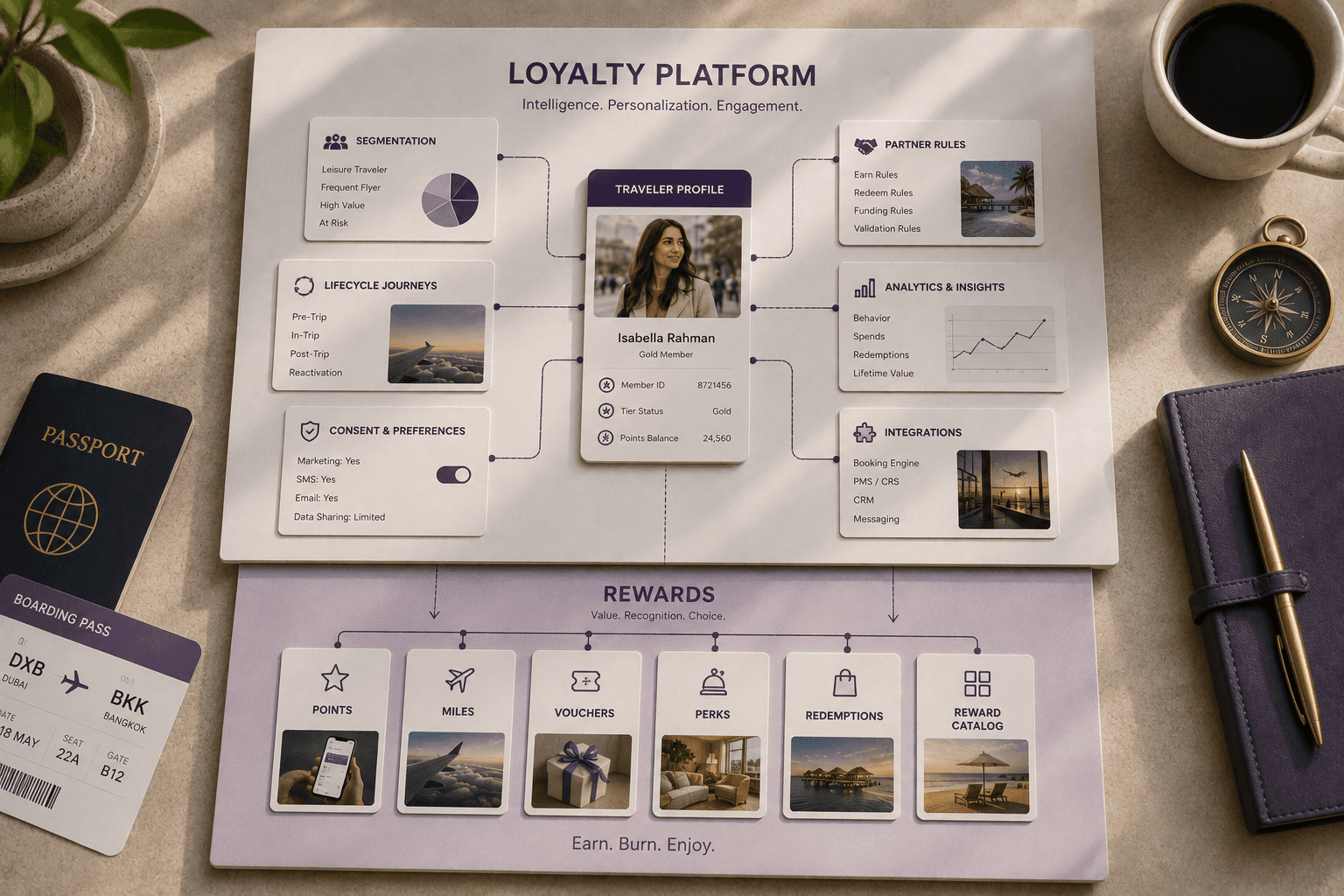
The terms are often used together, but they are not always the same.
Term | Typical focus | Limitation if used alone |
|---|---|---|
Travel rewards platform | Points, miles, vouchers, perks, redemptions, reward catalog | May not include deep segmentation, lifecycle marketing, or customer data unification |
Travel loyalty software | Program rules, members, tiers, rewards, offers, reporting | May vary widely depending on vendor depth and integrations |
Travel loyalty platform | Rewards plus customer data, segmentation, journeys, partner rules, analytics, and integrations | Requires stronger implementation discipline and clearer operating ownership |
For a small travel brand, basic travel rewards software may be enough at first. For a hotel group, airline, OTA, or multi-brand travel ecosystem, a fuller travel loyalty platform is usually more appropriate because loyalty touches many systems and teams.
How airlines should evaluate loyalty software
Airline loyalty platforms have specific needs because frequent flyer programs are operationally complex.
Airlines often need:
Miles or points accrual by fare, route, cabin, partner, and promotion
Tier qualification logic
Status benefits and exceptions
Partner earning and redemption
Ancillary offer targeting
Family or household account options
Fraud and account takeover controls
Member service workflows
Liability and breakage reporting
Integration with booking, offer, order, payment, and customer service systems
Frequent flyer program software should also help airlines move beyond generic mass offers. A traveler who frequently books short-haul business routes should not receive the same journey as an occasional leisure traveler saving for a long-haul redemption.
For airlines, loyalty is both a customer experience system and a financial system. The platform must protect trust, reward value, and operational accuracy at the same time.
How hotels and hospitality brands should evaluate loyalty software
Hotels need a travel loyalty solution that supports both brand-level loyalty and property-level experience.
Useful hotel loyalty capabilities include:
Direct booking incentives
Stay history and guest preferences
Room upgrade and late checkout benefits
Dining, spa, event, and experience rewards
Property-level segmentation
Member rates and bonus campaigns
Guest recovery journeys
Family and group travel recognition
Lapsed guest reactivation
Integration with PMS, booking engine, CRM, and messaging tools
Hotel loyalty does not need to copy airline loyalty. The best hotel programs often win through recognition, convenience, and relevant experiences, not only points.
For example, a returning guest may value an early check-in, room preference, dining credit, or personalized local experience more than a small discount. The platform should make those benefits operationally possible and measurable.
How OTAs and travel marketplaces should evaluate loyalty software
OTAs and travel marketplaces need loyalty to increase repeat bookings in a category where comparison shopping is normal.
Useful OTA loyalty capabilities include:
Member-only rates or credits
Cross-sell between flights, hotels, activities, insurance, and transport
Personalized bundles
Destination-based segmentation
Coupon and reward controls
Supplier-funded offers
Post-trip reactivation
Referral and group travel incentives
Margin and promotion reporting
For marketplaces, the loyalty platform should be especially careful with offer economics. A reward that increases bookings but trains customers to wait for discounts can hurt long-term margin. The better goal is to use customer data to match the right offer to the right traveler at the right moment.
Partner loyalty can create utility, but it needs governance
Travel loyalty becomes more useful when members can earn and redeem across the journey.
An airline partner, hotel partner, restaurant group, mall, attraction, ride provider, event organizer, or payment partner can make the program more valuable. But partner loyalty also adds operational risk.
Before adding partners, define:
Which partners can issue rewards
Which partners can accept redemptions
How reward value is funded
How transactions are validated
How refunds and reversals affect points
What customer data is shared
What consent is required
How partner performance is reported
How fraud, duplicate accounts, and suspicious redemption are handled
How liability is reconciled
This is where a travel rewards platform needs strong ledger and rules infrastructure. Partner ecosystems are powerful, but they break down quickly when customers cannot understand the value, partners cannot reconcile activity, or finance cannot trust the numbers.
Travel loyalty campaigns that actually fit the journey
A travel loyalty platform should support journey-based campaigns, not just monthly newsletters.
Good travel loyalty journeys include:
Journey | Trigger | Example activation |
|---|---|---|
First booking welcome | New member books or joins | Explain member value, points, tier path, and direct booking benefits |
Pre-trip upsell | Upcoming trip | Offer upgrade, transfer, dining, experience, insurance, or add-on |
In-trip engagement | Arrival, check-in, or activity window | Surface relevant partner benefits or property offers |
Post-trip retention | Trip completed | Send points statement, review request, referral offer, and next-trip inspiration |
Lapse prevention | No booking after expected interval | Personalize by prior destination, trip type, or season |
Points expiry | Balance nearing expiry | Suggest reachable redemption or bonus earning opportunity |
Tier progress | Member close to next tier | Show qualification gap and relevant earning path |
Service recovery | Complaint or disruption | Trigger apology, support follow-up, or recovery offer |
The best campaigns are built from behavior. They use booking windows, trip type, destination interest, reward balance, and prior engagement to decide what to send.
What to measure in a travel loyalty program
Enrollment is not enough.
A travel brand can have a large member base and still struggle with repeat bookings. A travel loyalty platform should help teams measure whether members are behaving differently from non-members and whether rewards are profitable.
Track:
Repeat booking rate
Direct booking share
Member booking frequency
Average booking value
Ancillary revenue per member
Redemption rate
Reward liability
Points expiry and breakage
Tier movement
Partner earn and burn activity
Campaign conversion by segment
Lapsed member reactivation
Cost per retained traveler
Margin after rewards
The most useful reporting compares segments. A family traveler, corporate traveler, luxury traveler, weekend leisure traveler, and lapsed OTA booker should not be measured as one blended audience.
Common mistakes when choosing travel loyalty software
Avoid these traps when evaluating a travel loyalty solution.
Mistake 1: Buying a points engine without a customer data strategy
Points alone do not create personalization. If traveler data remains fragmented, the program will struggle to trigger relevant offers and measure retention.
Mistake 2: Making rewards too discount-heavy
Discounts can drive bookings, but they can also erode margin and train customers to wait. Travel loyalty should mix points with access, recognition, convenience, upgrades, and experiences.
Mistake 3: Launching too many partners too early
Partner loyalty is attractive, but every partner adds rule, data, finance, support, and reconciliation complexity. Start with the partner relationships that improve customer utility and can be measured clearly.
Mistake 4: Treating all travelers the same
Business, leisure, family, premium, event, and lapsed travelers have different booking windows and motivations. Segmentation should shape both rewards and messaging.
Mistake 5: Ignoring operational ownership
Loyalty touches marketing, ecommerce, operations, finance, customer service, partnerships, and technology. Before choosing software, define who owns program rules, reward funding, reporting, campaign execution, and member support.
How CXForge fits the travel loyalty use case
CXForge is built around the idea that loyalty and customer data should work together.
For travel brands, that means the loyalty platform should not sit separately from traveler identity, segmentation, campaign journeys, and retention analytics. The stronger operating model is to connect:
Loyalty profiles
Reward rules
Customer data
Segments
Lifecycle campaigns
Partner activity
Performance reporting
That combination helps teams move from "we have a rewards program" to "we understand which travelers are coming back, why they are coming back, and what should happen next."
For airlines, hotels, OTAs, and travel groups, the practical starting point is a loyalty architecture audit:
Map current traveler data sources.
Identify the highest-value repeat booking segments.
Define the first set of rewards and benefits.
Decide which partner rules are needed now versus later.
Build lifecycle journeys around the trip stages.
Set measurement around repeat bookings, direct share, margin, and retention.
That keeps the program grounded in business outcomes instead of features.
Travel loyalty platform evaluation checklist
Use this checklist when comparing vendors.
Question | Why it matters |
|---|---|
Can the platform unify traveler profiles across booking, rewards, campaigns, and partners? | Prevents fragmented personalization and reporting |
Does it support points, tiers, perks, vouchers, offers, and partner rules? | Gives flexibility beyond one reward mechanic |
Can teams segment travelers by behavior, value, trip type, and lifecycle stage? | Enables relevant journeys |
Does it provide an auditable ledger for earn, burn, expiry, refunds, and adjustments? | Protects finance, trust, and support operations |
Can it integrate with existing booking, CRM, PMS, ecommerce, messaging, or analytics tools? | Reduces operational silos |
Does it support consent and preference management? | Keeps personalization permission-based |
Can it report repeat booking and margin after rewards? | Connects loyalty to business performance |
Is partner loyalty manageable without custom work for every rule? | Supports ecosystem growth |
Can non-technical teams manage offers and campaigns safely? | Speeds up execution |
Does the vendor understand travel loyalty, not just generic ecommerce loyalty? | Improves implementation quality |
FAQ
What is a travel loyalty platform?
A travel loyalty platform is software that helps airlines, hotels, OTAs, and travel groups manage loyalty members, rewards, tiers, offers, customer data, partner rules, and retention journeys.
What is the difference between travel rewards software and a travel loyalty platform?
Travel rewards software often focuses on points, perks, and redemptions. A travel loyalty platform usually combines rewards with traveler profiles, segmentation, lifecycle campaigns, partner management, and analytics.
What should airlines look for in frequent flyer program software?
Airlines should look for miles or points accrual, tier rules, partner earning and redemption, ancillary offer targeting, fraud controls, member service workflows, liability reporting, and integrations with booking and retailing systems.
How can hotels use a travel loyalty platform?
Hotels can use a travel loyalty platform to increase direct bookings, recognize returning guests, manage upgrades and perks, reward dining or spa spend, run post-stay journeys, and reactivate lapsed guests.
Do travel loyalty programs need partner rewards?
Not always. Partner rewards can increase value when they make the travel journey more useful, but they require clear rules for funding, consent, data sharing, reconciliation, fraud controls, and reporting.
How should travel brands measure loyalty program success?
Travel brands should measure repeat booking rate, direct booking share, member booking frequency, ancillary revenue, redemption activity, tier movement, partner performance, reward liability, and margin after rewards.
Related reading
For a deeper look at connecting loyalty strategy with customer data, segmentation, and lifecycle campaigns, read our guide on CDP + loyalty platform integration.
If traveler profiles are fragmented across booking, CRM, rewards, and campaign tools, see how to build a Customer 360 for B2C CRM without a full enterprise CDP.
If your travel loyalty program includes partner earning, partner redemption, family accounts, or high-value rewards, review our guide to preventing loyalty program fraud.
For travel ecosystems that depend on airlines, hotels, restaurants, attractions, or payment partners, read our overview of coalition loyalty programs.
To plan expiry rules, member communication, and reactivation journeys, read our guide on loyalty points expiration policy.