Loyalty Program Pricing: What a Modern Loyalty Platform Should Cost
Updated on:
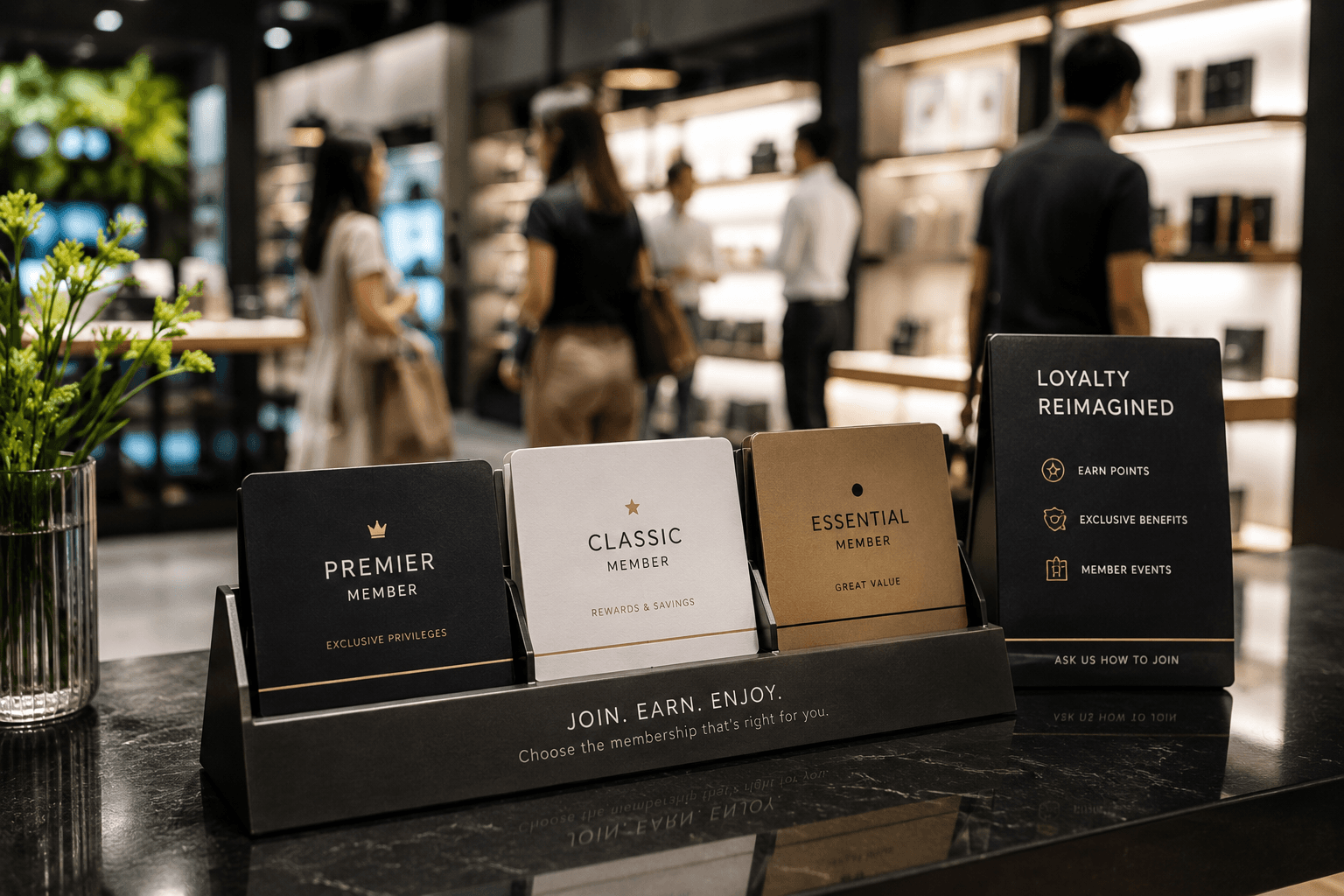
Loyalty program pricing is difficult to compare because every vendor packages the category differently.
One platform charges by active members. Another charges by orders, transactions, or monthly revenue. Another shows a low entry price, then adds fees for SMS, referrals, tiers, analytics, API access, integrations, onboarding, mobile app features, or higher support levels.
For a loyalty manager, CRM manager, ecommerce operator, or founder, the question is not "which platform has the cheapest monthly plan?" The better question is:
What will it cost to run a loyalty program that customers actually use, staff can operate, and finance can justify?
That is the lens this guide uses. We will break down the main loyalty program cost drivers, explain where hidden fees usually appear, and show how to compare loyalty platform pricing before you commit.
Key Findings
Loyalty program pricing should be evaluated as a retention investment, not only a software subscription.
The biggest cost drivers are active member volume, program mechanics, integrations, campaign channels, implementation work, migration, support, and analytics depth.
Per-transaction fees can become expensive for growing retail, F&B, hospitality, and DTC brands because loyalty activity rises with customer engagement.
A low monthly fee can become a high total cost if core modules such as segmentation, WhatsApp, fraud controls, API access, app experiences, or data migration are sold separately.
Buyers should compare vendors using total cost of ownership, not headline plan names.
CXForge pricing is designed around active-member tiers, unlimited transactions, white-label app inclusion, omnichannel campaigns, API/webhooks, Shopify/WooCommerce integrations, and implementation support.
What Is Loyalty Program Pricing?
Loyalty program pricing is the total cost of launching, running, and improving a customer loyalty program.
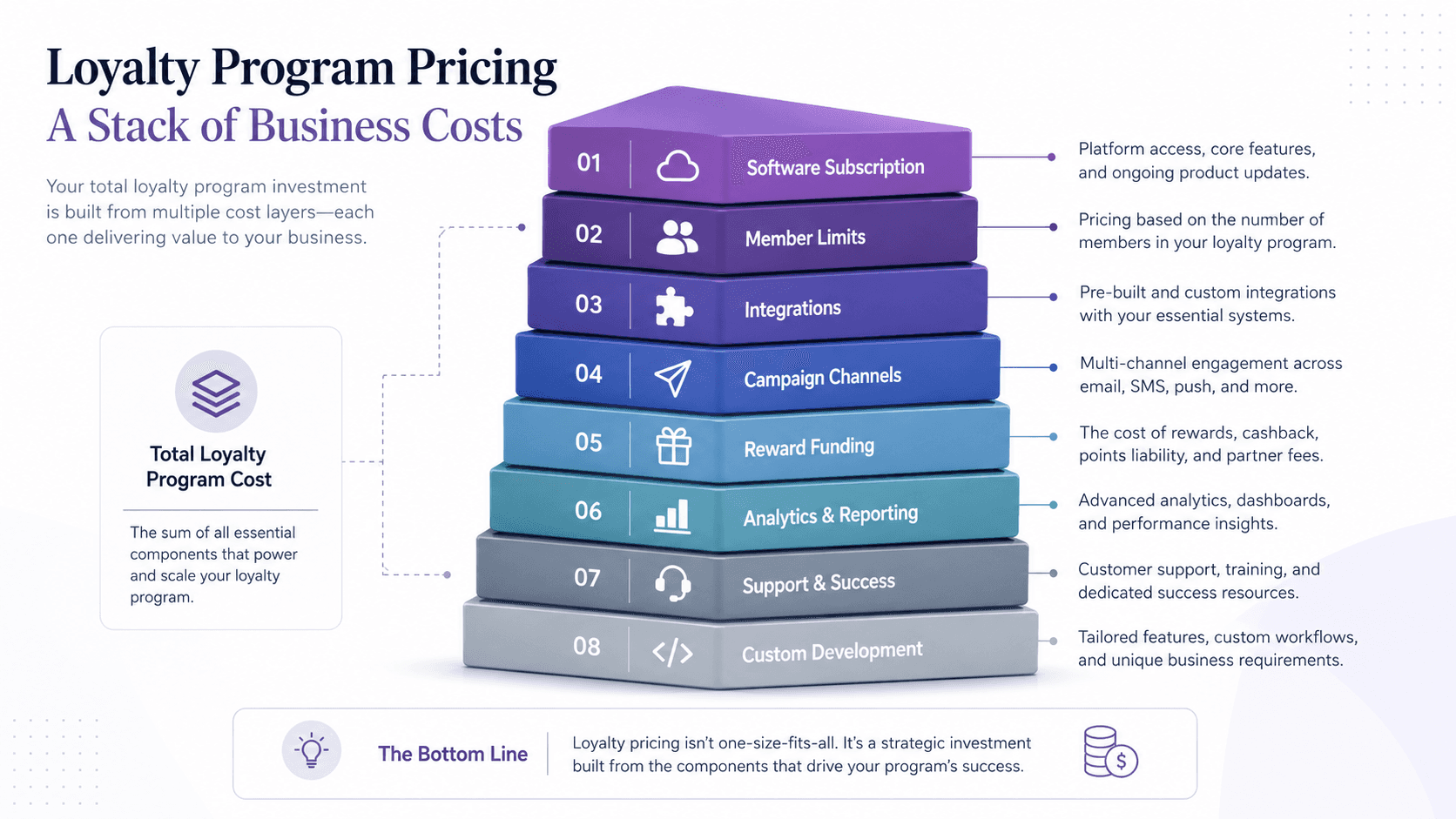
It usually includes:
loyalty platform subscription
active member or customer profile limits
transaction or order fees, if the vendor charges them
setup, onboarding, and implementation
data migration from an old loyalty system
ecommerce, POS, CRM, ERP, CDP, app, or messaging integrations
campaign channel costs such as SMS, WhatsApp, email, or push notifications
reward funding, vouchers, cashback, points liability, or partner-funded benefits
analytics, reporting, and ROI measurement
support, training, managed services, or customer success
custom development for complex use cases
The platform subscription is only one part of the business case. A loyalty program also affects discounting, margin, reward liability, marketing spend, customer service, and operational workload.
That does not mean loyalty should be expensive. It means the right pricing model should be clear, scalable, and tied to the program's commercial value.
Why Loyalty Platform Pricing Varies So Much
Loyalty software is not one fixed product category.
Some tools are lightweight Shopify points plugins. Some are enterprise loyalty engines for airlines, hotels, and banks. Some are CRM suites with loyalty features. Some are customer data platforms with campaign activation. Some are managed loyalty platforms that combine software, implementation, white-label experiences, and retention strategy.
Pricing changes because vendors are solving different scopes.
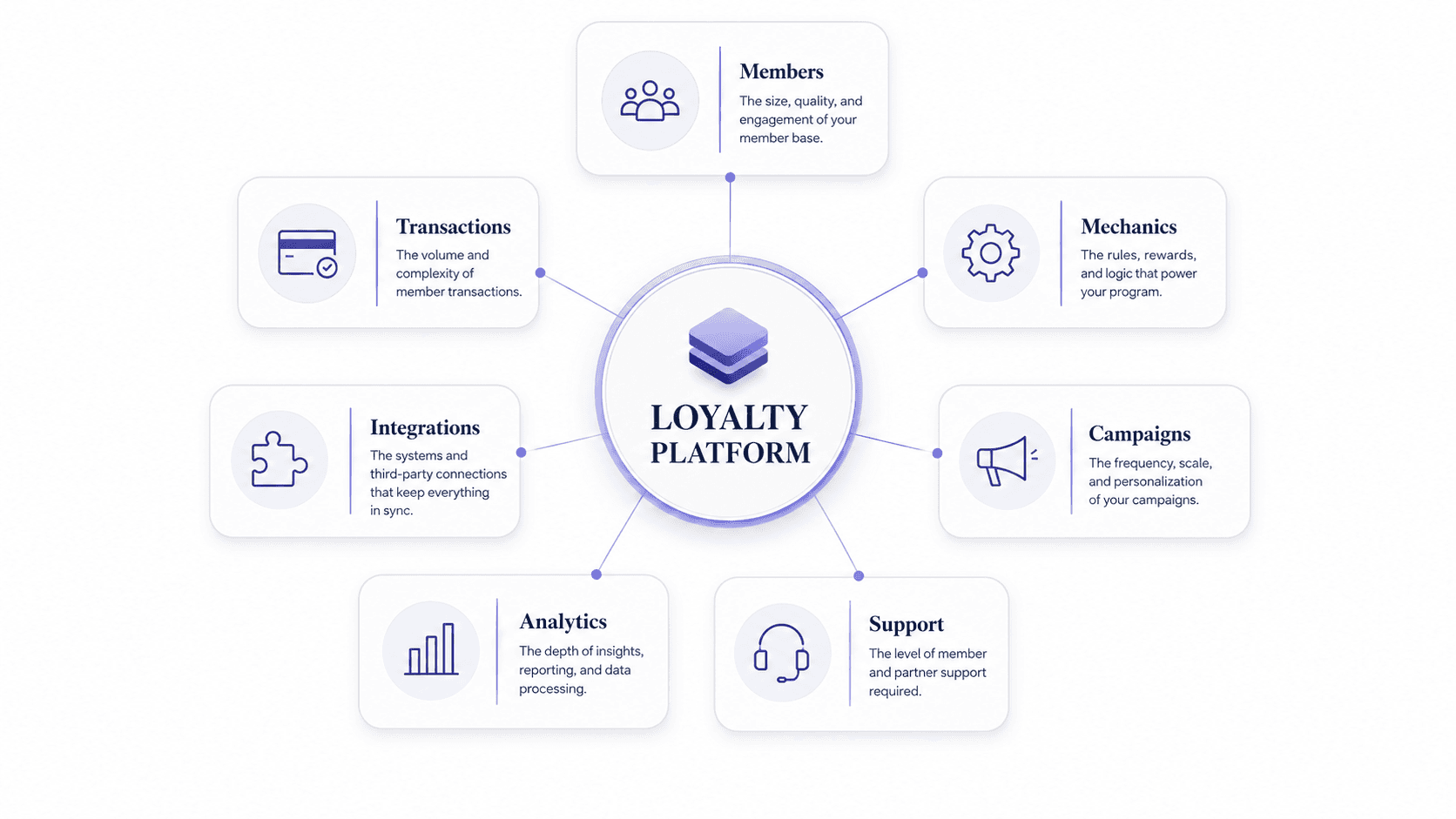
Cost driver | Why it affects pricing | What to ask |
|---|---|---|
Active members | Larger programs need more profile storage, events, calculations, and support | Is pricing based on enrolled members, active members, or contacts? |
Transactions | Some vendors charge per order, visit, scan, or reward event | Are transactions unlimited or usage-based? |
Program mechanics | Points, tiers, referrals, wallets, gamification, and partner rewards add rule complexity | Which mechanics are included in each plan? |
Integrations | POS, ecommerce, CRM, ERP, messaging, and app integrations determine launch effort | Which integrations are native, and which require custom work? |
Campaign channels | SMS, WhatsApp, email, push, and wallet updates may have separate messaging costs | Are campaign tools included, and are channel costs passed through? |
Data and analytics | Segments, customer profiles, dashboards, attribution, and exports vary by plan | Can the team measure retention, revenue, and reward cost? |
Support | Onboarding, training, managed services, SLAs, and reviews affect service cost | What support do we get after launch? |
Multi-brand or coalition needs | Partner earn and burn, ledgers, settlement, and permissions add complexity | Can the platform handle shared rewards and partner reporting? |
The same brand could look "small" by number of stores but complex by integrations. A single-location F&B brand with high transaction volume may need different pricing than a DTC brand with fewer orders but richer lifecycle campaigns.
The Seven Biggest Loyalty Program Cost Drivers
1. Active Members and Customer Profiles
Many loyalty platforms price by member count because member volume affects storage, identity resolution, segmentation, campaign volume, analytics, and support.
The important detail is how the vendor defines a member.
Ask whether pricing is based on:
enrolled members
active members
monthly active members
customer profiles
contacts synced from ecommerce or CRM
subscribers with marketing consent
total historical customers
For most growing brands, active-member pricing is easier to reason about than total historical contact pricing. A customer who bought once three years ago should not necessarily have the same commercial weight as a currently active loyalty member.
For CXForge, active members are the meaningful usage unit. Enrolled members and transactions should not create surprise penalties when a program performs well.
2. Transaction Volume
Per-transaction pricing can look harmless at launch, then become expensive as the program succeeds.
Retail, F&B, and hospitality programs often create many loyalty events:
enrollment
purchase earn
bonus points
points redemption
voucher issue
voucher use
tier upgrade
referral reward
campaign trigger
points adjustment
refund reversal
expired reward
If a vendor charges for transactions or events, the bill can rise when customers engage more often. That can create an awkward incentive: the better the program performs, the more the operating cost scales.
CXForge positions unlimited transactions on all plans and no per-transaction fees. That keeps the cost model predictable as engagement grows.
3. Loyalty Mechanics and Reward Complexity
A simple points program costs less to configure than a full loyalty ecosystem.
Common mechanics include:
points earn and burn
digital wallet or member portal
tier or VIP program
referrals
birthday rewards
points multipliers
product or category bonuses
gamification
vouchers and coupons
cashback or stored value
family accounts or points pooling
coalition or multi-brand rewards
partner earn and redeem
The more flexible the rule engine, the more valuable the platform becomes. But buyers should check whether those mechanics are included or sold as add-ons.
For example, a vendor may include points but charge extra for referrals. Another may include tiers but limit the number of segments. Another may support multi-brand loyalty only on enterprise plans.
The right comparison is not "does the plan have loyalty?" It is "does the plan include the mechanics our program strategy requires for the next 12 months?"
4. Integrations and Implementation Scope
Loyalty fails when it is disconnected from the systems where customers actually buy and engage.
Most brands need some mix of:
POS integration
Shopify, WooCommerce, Magento, or custom ecommerce integration
CRM or customer database integration
email, SMS, WhatsApp, or push messaging
mobile app or web app integration
ERP, finance, or accounting exports
CDP or analytics tools
customer support tools
data warehouse or BI exports
Implementation cost depends on how standard those connections are.
A Shopify or WooCommerce launch with standard loyalty rules is usually simpler than a custom POS plus ERP plus mobile app plus partner redemption network. That is why a serious pricing discussion should ask about systems, data quality, store operations, and launch timeline before quoting.
CXForge includes full REST API access, webhooks, Shopify and WooCommerce integration, white-label apps, and onboarding in its current pricing materials. The pricing page and sales process should make those inputs clear so buyers understand what the quote covers.
5. Campaign Channels and Messaging Costs
Loyalty platforms increasingly include campaign activation because rewards are only useful if customers hear about them at the right time.
Common loyalty campaigns include:
welcome offers
first-to-second purchase nudges
points balance reminders
reward expiry reminders
birthday rewards
tier-near notifications
win-back journeys
VIP recognition
referral prompts
post-purchase follow-up
store reopening or local event campaigns
The cost question is twofold.
First, does the platform include campaign tools? Second, how are channel costs handled?
Email may be included or connected to a separate ESP. SMS and WhatsApp usually involve carrier or provider costs. Push notifications may depend on app setup. Wallet pass updates may depend on pass provider or platform architecture.
Buyers should avoid comparing platform subscriptions without understanding campaign channel economics. A loyalty platform that includes omnichannel campaign orchestration can reduce tool sprawl, but messaging usage still needs to be visible.
6. Data, Segmentation, and Analytics
Basic points software can tell you how many points were issued. A stronger loyalty platform helps you understand whether the program is changing customer behavior.
Useful loyalty analytics include:
enrollment rate
active member rate
repeat purchase rate
visit frequency
average order value
redemption rate
reward cost
points liability
campaign revenue attribution
cohort retention
customer lifetime value
churn or lapse risk
store or location performance
segment performance
margin after rewards
Data capability affects pricing because it requires event capture, customer profile unification, dashboards, exports, and sometimes identity resolution.
This is where loyalty platform pricing overlaps with customer data strategy. If a brand wants customer segmentation for loyalty programs, personalization, lifecycle automation, and ROI reporting, it should not choose a tool that only handles a points ledger.
7. Support, Onboarding, and Managed Services
The cheapest software can become expensive if the internal team has to figure everything out alone.
Ask what is included:
implementation planning
data migration support
loyalty rules configuration
integration support
QA before launch
staff training
campaign setup
program launch checklist
ongoing support
performance reviews
SLA commitments
named customer success manager
Some teams want self-service. Others need a guided rollout because the loyalty program touches stores, ecommerce, finance, marketing, customer service, and operations.
CXForge's current pricing material references a 2-4 week average go-live, dedicated onboarding on growth plans, performance reviews, and dedicated CSM support for enterprise plans. Those are not just service details. They are pricing justification because they reduce launch risk.
Common Loyalty Software Pricing Models
Fixed Monthly or Annual Plans
Fixed plans are easy to understand. The vendor defines tiers, features, limits, and support levels.
This model works well when each plan maps to a clear customer stage: launch, growth, and enterprise.
Watch for feature cliffs. A plan can look affordable until essential capabilities sit one tier higher.
Active Member Pricing
Active member pricing scales with the size of the usable loyalty base.
This can be fair when the definition is clear and the plan includes enough transactions, campaigns, and features. It becomes confusing when the vendor counts every historical profile or imported contact.
Transaction or Order-Based Pricing
Transaction pricing scales with purchase volume or loyalty events.
This may work for some vendors, but buyers should model a good month, a seasonal peak, and a high-growth scenario. If the platform becomes meaningfully more expensive every time the program performs better, the pricing model may fight the business case.
Revenue-Share or Performance Pricing
Some providers charge a percentage of revenue, incremental revenue, reward value, or sales influenced by the program.
This can align incentives if measurement is rigorous, but it can also create attribution disputes. Define what counts as influenced revenue, how returns are handled, how discounts are treated, and whether baseline sales are excluded.
Enterprise Quote-Based Pricing
Custom pricing is common when the program needs complex integrations, high member volume, multi-brand rules, partner settlement, custom apps, regional requirements, or contractual SLAs.
Quote-based pricing is not a red flag by itself. It becomes a problem only when the buyer cannot understand what drives the quote.
What Should Be Included in a Loyalty Platform Quote?
A useful quote should make the operating model clear.
At minimum, ask vendors to specify:
plan tier and billing term
member or active-member limits
transaction, order, or event limits
included loyalty mechanics
included campaign channels
native integrations
custom integration assumptions
API and webhook access
data migration scope
implementation timeline
onboarding and training
analytics and reporting features
support level and response expectations
security, permissions, and audit capabilities
one-time fees
recurring fees
pass-through channel costs
renewal terms
overage rules
If a vendor cannot explain these clearly, the buying team will struggle to defend the decision internally.
How to Compare Loyalty Platform Pricing Without Getting Misled
Use a total cost of ownership view.
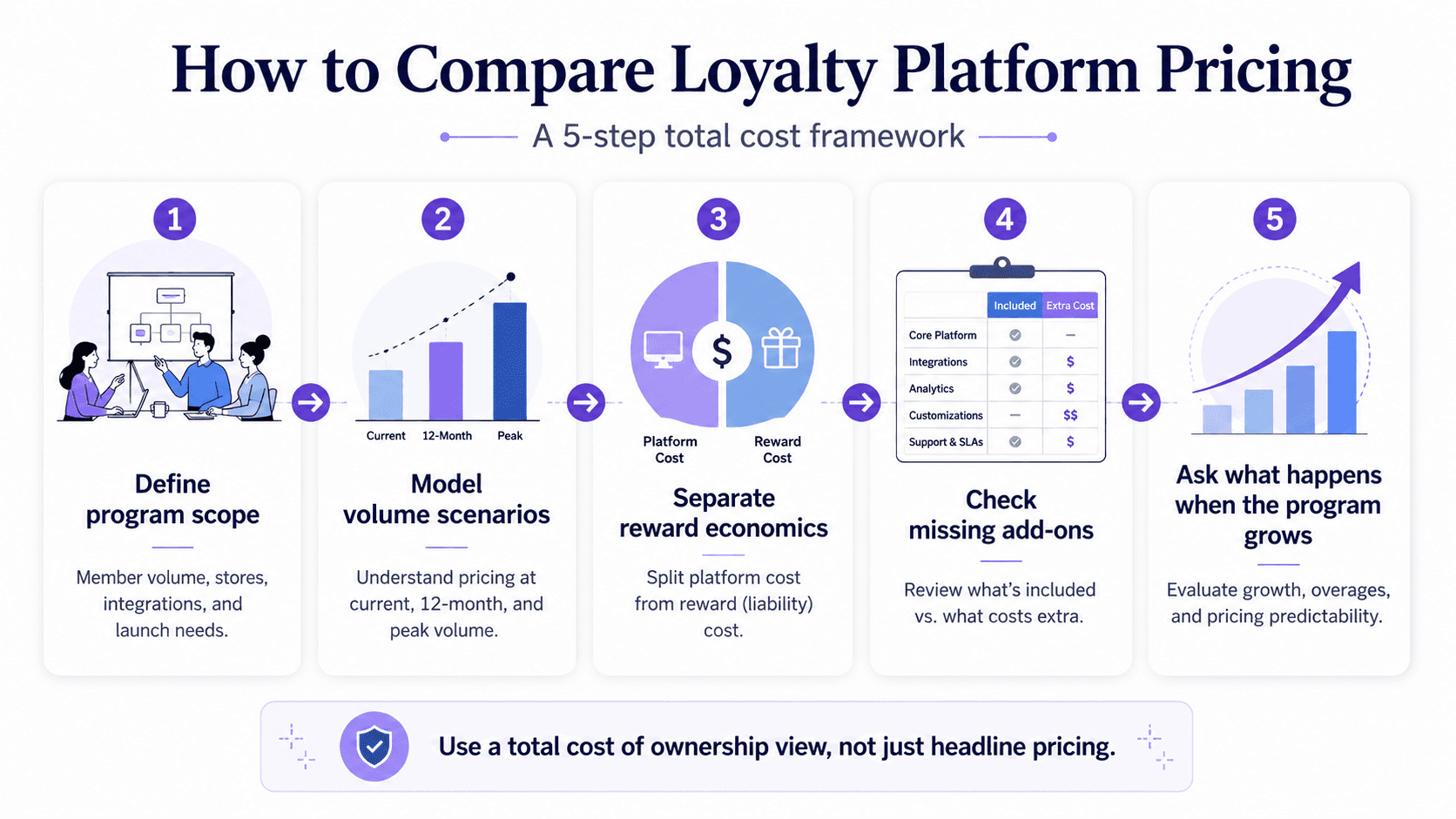
Step 1: Define the Program You Actually Need
Write down the program scope before looking at vendor plan pages.
For example:
40,000 active members
Shopify ecommerce plus 12 stores
POS integration
points, tiers, referrals, and birthday rewards
SMS and WhatsApp campaigns
customer segmentation
dashboard for repeat purchase and reward cost
data migration from an existing platform
launch in 6 weeks
That makes pricing conversations practical. You are no longer asking "how much is loyalty software?" You are asking "how much is this operating model?"
Step 2: Model Three Volume Scenarios
Do not model only today's business.
Model:
current volume
12-month expected volume
seasonal or campaign peak volume
Include active members, transactions, messages, stores, campaigns, and integrations.
This quickly exposes per-transaction fees, message costs, and plan limits that may not matter at launch but matter later.
Step 3: Separate Platform Fees From Reward Economics
Platform cost is not the same as reward cost.
A loyalty platform might cost a fixed subscription. The reward strategy has its own economics:
points issued
points redeemed
discounts funded
vouchers redeemed
cashback paid
partner-funded rewards
breakage assumptions
fraud or abuse leakage
margin after rewards
Finance needs both views. A platform that improves targeting and reduces blanket discounting can justify a higher subscription if it lowers waste and improves incremental margin.
For a deeper measurement model, use a loyalty program ROI calculator before comparing vendor quotes.
Step 4: Check What Is Missing From the Base Plan
Create a simple "included or extra" table.
Capability | Included? | Extra cost? | Why it matters |
|---|---|---|---|
Points and rewards | Core loyalty engine | ||
Tiers or VIP | Recognition and status | ||
Referrals | Member-led acquisition | ||
Segmentation | Personalization and lifecycle targeting | ||
Campaign automation | Activation after enrollment | ||
SMS/WhatsApp/email | Reach and engagement | ||
Shopify/WooCommerce/POS | Transaction capture and redemption | ||
API/webhooks | Custom workflows and data flow | ||
Analytics | ROI and executive reporting | ||
Data migration | Switching without losing balances | ||
Fraud controls | Liability and abuse prevention | ||
Support/onboarding | Launch risk reduction |
The cheapest plan is rarely cheapest if it excludes what the team needs to succeed.
Step 5: Ask How Pricing Changes When the Program Works
This is the most revealing question:
If active members, visits, rewards, and campaigns double, what happens to the bill?
A good loyalty platform should make growth predictable. There may be tier changes, but the vendor should be able to explain them before the contract is signed.
Loyalty Program Pricing for Different Brand Types
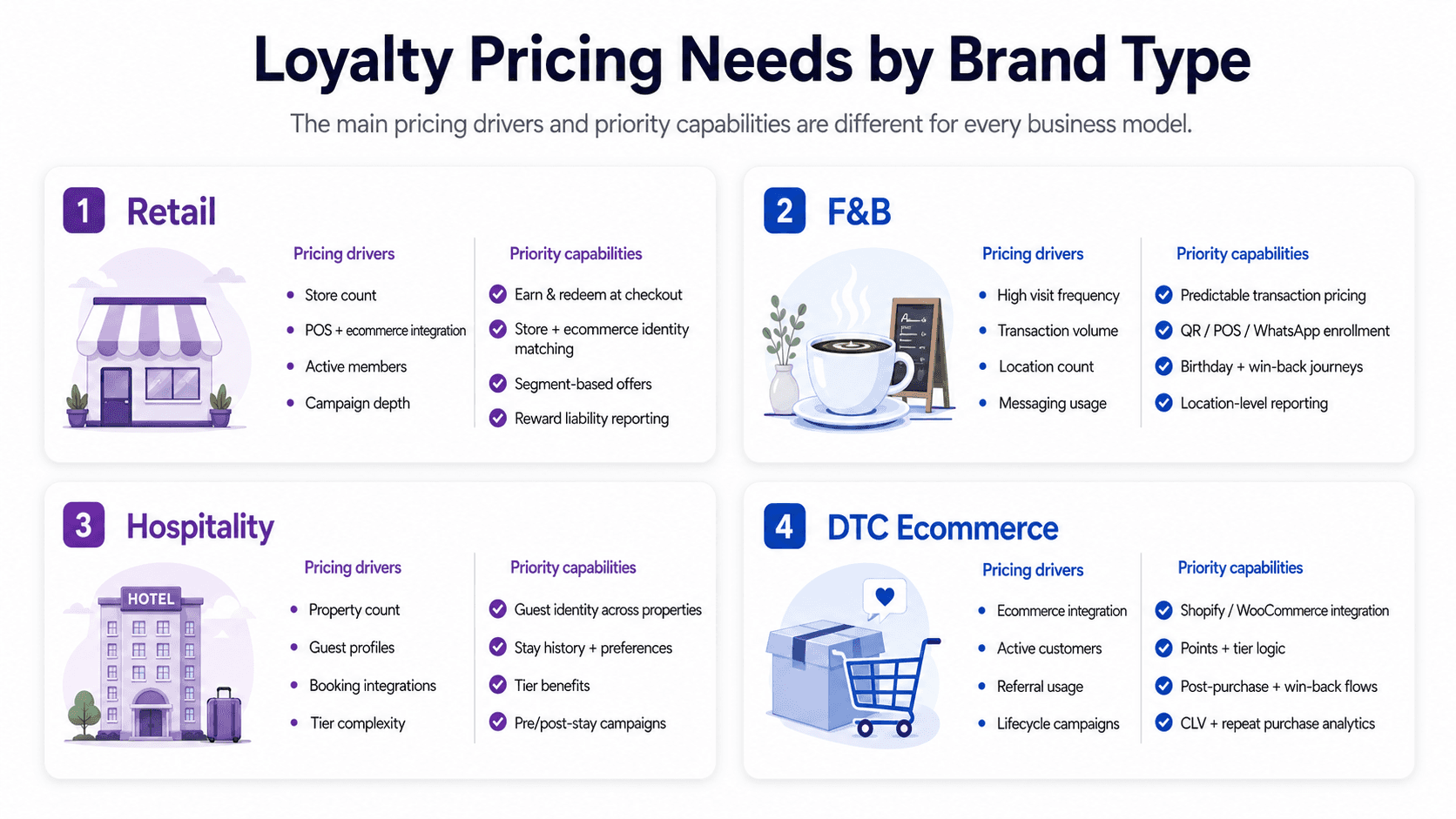
Retail Brands
Retail loyalty pricing usually depends on store count, POS integration, ecommerce integration, active members, campaigns, and segmentation depth.
Retailers should prioritize:
reliable earn and redeem at checkout
product or category bonuses
store and ecommerce identity matching
segment-based offers
reward liability reporting
staff-friendly customer lookup
campaign attribution by store or channel
If retail is your main use case, compare these needs against the best loyalty program software for retail checklist.
F&B and Restaurant Groups
F&B loyalty programs often have high visit frequency and operationally sensitive redemption flows.
F&B buyers should prioritize:
unlimited or predictable transaction pricing
QR, POS, and WhatsApp enrollment
visit frequency and recency segments
birthday and win-back journeys
location-level reporting
fraud and duplicate account controls
simple reward redemption for staff
Hospitality Brands
Hospitality loyalty pricing may depend on property count, booking systems, guest profiles, stay data, experiences, partner rewards, and tier recognition.
Hospitality buyers should prioritize:
guest identity across properties
stay and spend history
tier benefits
partner or experience rewards
preference and consent data
lifecycle campaigns before and after stays
service recovery and manual adjustment controls
DTC Ecommerce Brands
DTC loyalty pricing usually centers on ecommerce integration, active customers, referrals, lifecycle campaigns, and retention analytics.
DTC buyers should prioritize:
Shopify or WooCommerce integration
referral tracking
points and tier logic
email/SMS integration
post-purchase and win-back automation
customer segments by RFM, category, and margin
CLV and repeat purchase measurement
For ecommerce teams comparing packaged loyalty tools, see the Smile.io alternatives and LoyaltyLion vs Yotpo vs CXForge guides.
Multi-Brand and Coalition Programs
Multi-brand loyalty pricing is more complex because the platform may need partner rules, shared currencies, settlement, permissioned data views, and cross-brand analytics.
Buyers should prioritize:
partner onboarding
earn and burn rules by merchant
liability ledger
settlement reporting
customer consent and data-sharing controls
fraud monitoring
partner dashboards
governance workflows
This is where a simple ecommerce points plugin usually breaks down.
What CXForge Buyers Should Expect From a Pricing Conversation
For CXForge, a strong pricing conversation should help the buyer understand fit and scope quickly.
The conversation should cover:
What type of business are you running: retail, F&B, hospitality, DTC, travel, or multi-brand?
How many active members or customers should the program support?
Which systems need to connect: POS, ecommerce, CRM, ERP, app, messaging, or data warehouse?
Which loyalty mechanics do you need at launch: points, tiers, referrals, wallets, campaigns, coalition, gamification, or fraud controls?
Are you migrating from another loyalty platform?
Which campaign channels matter: SMS, email, WhatsApp, push, web, app, or wallet?
What does success mean: repeat purchase, visit frequency, CLV, campaign revenue, churn reduction, or partner engagement?
What timeline and support level do you need?
That gives both sides a better quote. It also helps the buyer avoid paying for complexity they do not need yet.
A Practical Loyalty Program Pricing Checklist
Before choosing a loyalty platform, answer these questions.
Program Scope
How many active members do we have now?
How many active members do we expect in 12 months?
How many stores, ecommerce sites, brands, or markets are included?
Which loyalty mechanics are launch-critical?
Which mechanics can wait?
Data and Integrations
Which POS, ecommerce, CRM, ERP, app, and messaging systems need to connect?
Is there a clean customer ID across systems?
Do we need API or webhook access?
Do we need data exports or BI access?
Are we migrating points, tiers, vouchers, consent, or history from an old platform?
Campaigns
Which channels will we use?
Are SMS, WhatsApp, email, push, or wallet updates included?
Are message costs included, passed through, or billed separately?
Can we build segments and automated journeys without another tool?
Commercial Model
Is pricing based on active members, enrolled members, contacts, transactions, orders, or revenue?
Are transactions unlimited?
What are the overage rules?
Which features are add-ons?
What one-time fees apply?
What support is included?
ROI
What retention metric will we improve first?
How will we measure incremental revenue?
How will we track reward cost and margin?
How will we report performance to leadership?
Red Flags in Loyalty Software Pricing
Watch for these signs:
Pricing is unclear about what counts as a member.
The plan charges per transaction without a realistic volume model.
Essential modules are only visible after a sales call.
API access is restricted even though the program needs integrations.
Campaign tools exist, but channel costs are vague.
Data migration is not scoped.
Analytics show activity but not retention or revenue outcomes.
Support is limited during launch.
Fraud controls, audit logs, or permissions are missing for higher-risk programs.
The vendor cannot explain how pricing changes as the program grows.
None of these automatically disqualifies a vendor. But each one should trigger a deeper question before procurement.
Final Takeaway
Loyalty program pricing should be predictable, transparent, and tied to the outcomes the program is meant to create.
The best platform is not always the lowest monthly subscription. It is the platform that gives your team the right loyalty mechanics, data, integrations, campaigns, support, and analytics at a cost that still makes sense as the program grows.
For retail, F&B, hospitality, and DTC brands, that means looking beyond plan names and asking practical questions:
Can customers earn and redeem easily?
Can the team launch without months of custom work?
Can marketing segment and activate members?
Can finance see reward cost and revenue impact?
Can operations trust the integration?
Can the platform scale without punishing transaction growth?
That is how loyalty platform pricing becomes a business decision instead of a software guessing game.
CTA
Planning a loyalty program or comparing platform quotes? CXForge can help you map your member volume, integrations, launch scope, campaign channels, and retention goals into a practical pricing plan. Book a free 30-minute demo to see which plan fits your program and what implementation would include.
FAQ
How much does a loyalty program cost?
Loyalty program cost depends on active members, transaction volume, program mechanics, integrations, campaign channels, support, implementation, and reward economics. A basic points program costs less than a multi-location or multi-brand loyalty ecosystem with POS integration, segmentation, campaigns, analytics, and data migration.
What affects loyalty software pricing the most?
The biggest drivers are active member volume, included features, integrations, implementation scope, campaign channel usage, support level, and whether the vendor charges by transactions, orders, revenue, or profiles.
Is per-transaction pricing good for loyalty programs?
It can work for some use cases, but growing brands should model the cost carefully. If every purchase, reward, adjustment, or campaign event increases the bill, the platform can become more expensive as engagement improves.
What should be included in loyalty platform pricing?
A loyalty platform quote should explain member limits, transaction rules, included loyalty mechanics, campaign channels, integrations, API access, analytics, onboarding, data migration, support, one-time fees, recurring fees, and overage rules.
Why do some loyalty platforms use custom pricing?
Custom pricing is common when the program needs complex integrations, high member volume, custom mobile app features, multi-brand rules, partner settlement, migration, SLAs, or dedicated support.
How should a retailer compare loyalty program pricing?
Retailers should compare total cost of ownership, not just monthly subscription. Include POS and ecommerce integrations, active members, transaction rules, campaign channels, segmentation, reward cost, analytics, support, and growth scenarios.
Does CXForge charge per transaction?
CXForge's current pricing material positions unlimited transactions on all plans and no per-transaction fees. Confirm the live pricing page before publishing if the public page has changed.
What is the best pricing model for a loyalty platform?
The best pricing model is one the buyer can forecast. For many consumer brands, active-member tiers plus clear included features are easier to manage than unpredictable transaction, event, or revenue-based fees.