Build a Loyalty Program in Saudi Arabia
Updated on:

Key findings
In KSA, loyalty competes with ecosystem programs (telco, banks, wallets, travel, grocery), so standalone points programs need stronger owned value and/or partner utility.
Mobile-first is non-negotiable: enrollment, balance, redemption, and service must work in seconds on a phone.
Treat trust as a conversion lever: transparent reward value, clear rules (especially expiry), and visible support reduce drop-off.
Build PDPL-aware consent + preference management into the loyalty foundation (not as a later “compliance project”).
Win with segmentation and lifecycle automation, not only tiering: second-purchase activation, lapsed-VIP recovery, and calendar-based campaigns outperform generic blasts.
Measure loyalty as unit economics (incremental margin + liability + breakage), not just sign-ups and points issued.
Quick answer: A successful loyalty program in Saudi Arabia is mobile-first, trust-led, PDPL-aware, and built on an owned customer identity layer that connects store + ecommerce, then uses segmentation and lifecycle automation to drive second purchases and profitable repeat behavior (not endless discounts).
Saudi Arabia is a high-potential market for loyalty-led growth, but it’s not a “copy-paste” environment.
Customers in KSA already earn and burn rewards through large ecosystems, telecom, banks/cards, wallets, airlines, malls, grocery apps, and partner redemption networks. If your program is just “join, earn points, get a coupon,” you’re competing against programs that are embedded into daily life.
This playbook helps retail, ecommerce, hospitality, and F&B teams design a loyalty program that:
Is mobile-first and simple to use.
Builds customer trust (clear value + clear rules).
Unifies customer identity across store and ecommerce.
Supports segmentation and lifecycle automation.
Is designed with PDPL in mind.
Can be measured as real incremental profit.
What “success” looks like in KSA (a clear definition)
A successful loyalty program in Saudi Arabia does three jobs at once:
Creates repeatable behavior
It reliably moves customers to a next step: second purchase, higher frequency, cross-category, or reactivation.Creates an owned customer data layer
It links identity, transactions, channel behavior, and marketing preferences across your stack.Creates credible value
Customers understand what their points are worth, what they can redeem today, and why staying a member is worth it.
Step 1: Decide your loyalty architecture (owned, ecosystem, or hybrid)
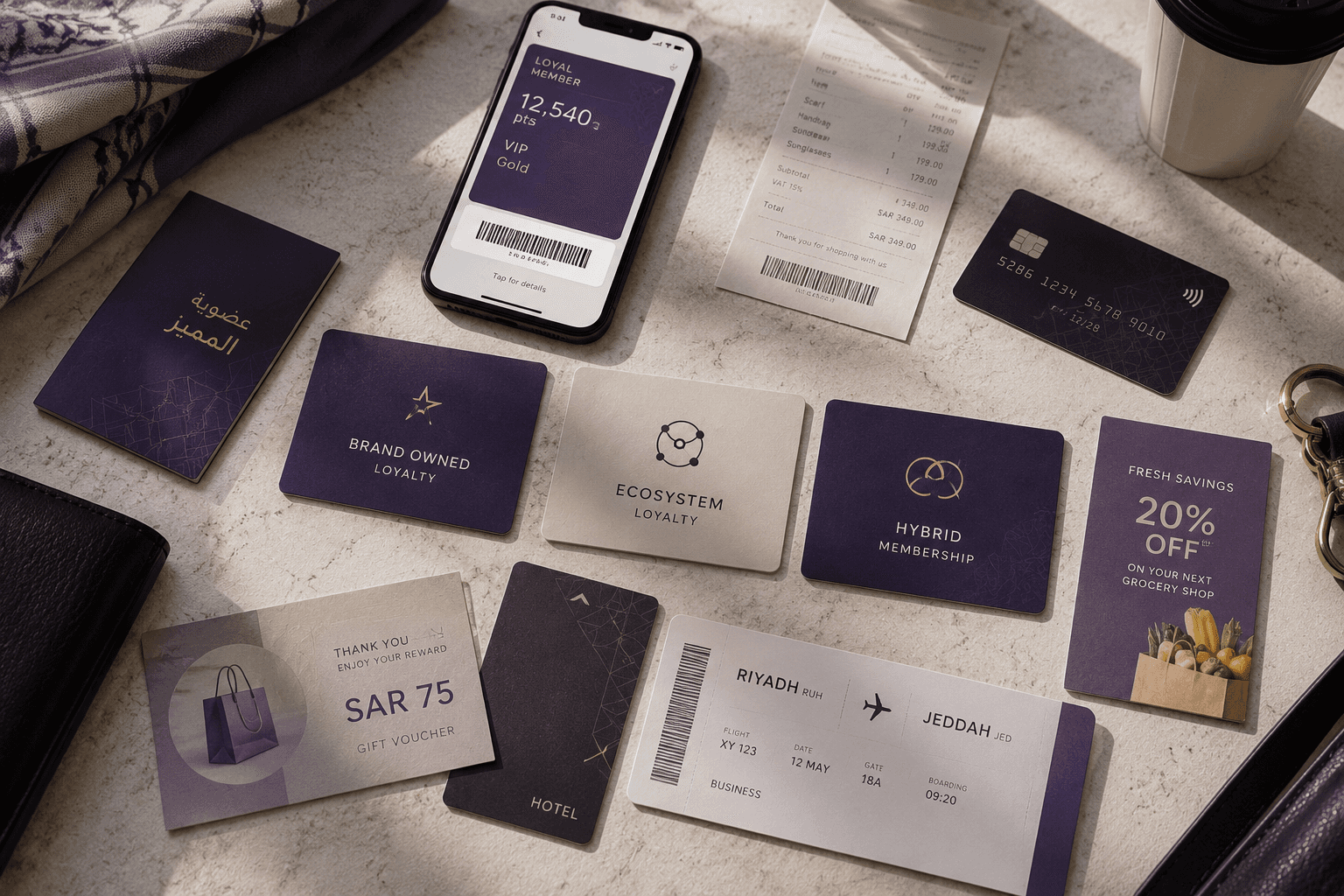
Before you design tiers and rewards, choose how you’ll compete in an ecosystem-driven market.
Owned program only (best for brands with strong repeat + product love)
Strength: full control of data + experience
Risk: lower redemption “utility” vs big ecosystems
Recommendation: invest in experience + segmentation; make value obvious.Ecosystem-led (best for low-frequency categories)
Strength: faster reach + attractive partner redemptions
Risk: you can lose ownership of identity + insights
Recommendation: use ecosystems strategically, but keep an owned member ID + consent.Hybrid (owned + partner utility) (best default for most mid-market brands)
Strength: owned data + partner utility for perceived value
Risk: integration + governance complexity
Recommendation: start with the owned data layer, then add selective partners once the owned experience performs.
If you run stores and ecommerce, hybrid is usually the most defensible: you want an owned identity layer, but you may add partner redemption or wallet-friendly vouchers to raise perceived value.
Step 2: Make mobile enrollment and redemption frictionless
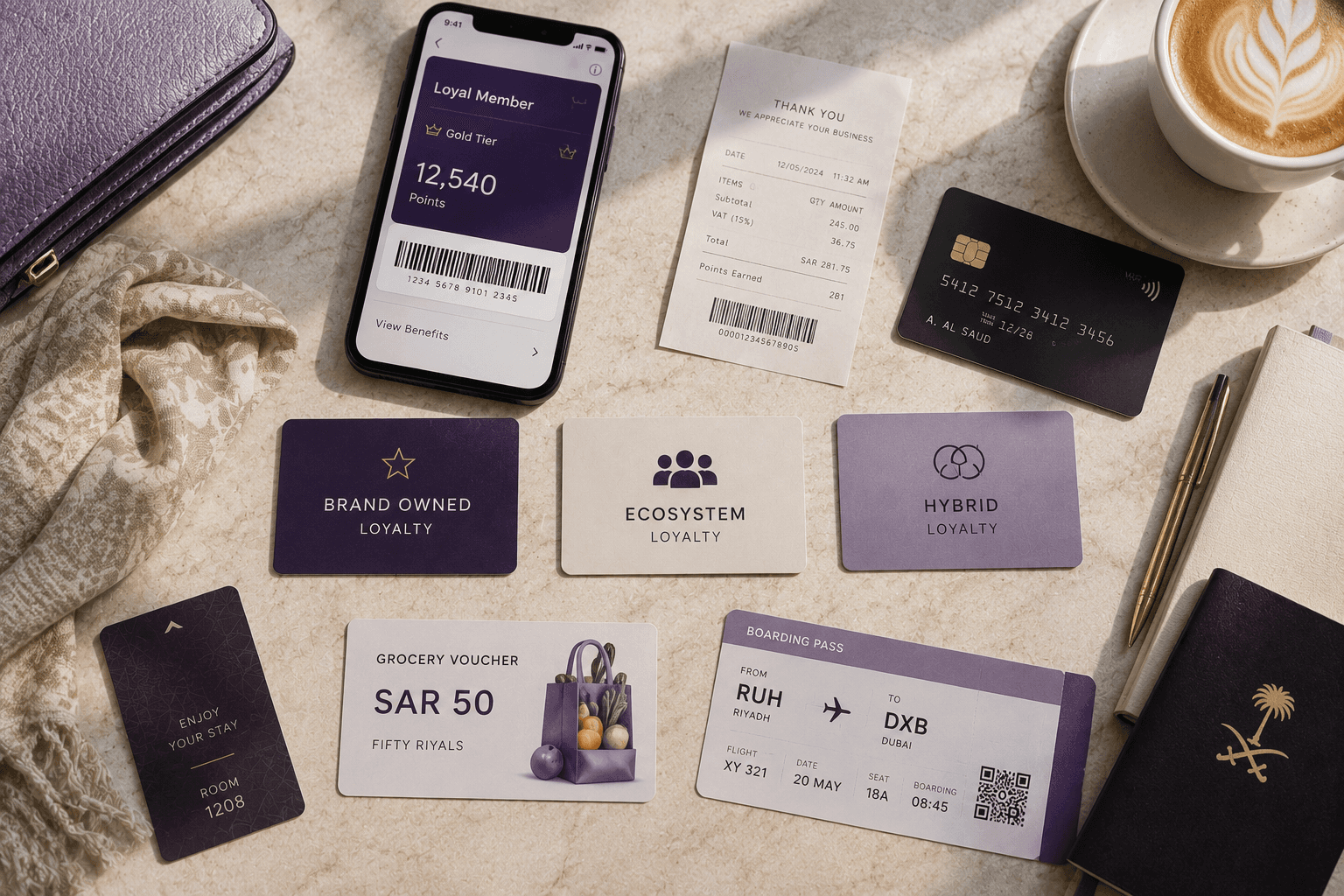
Saudi loyalty is mobile-first. Treat “time-to-first-value” as a core KPI.
Targets that usually work:
Enrollment in under 60 seconds.
First visible benefit immediately (welcome reward, points balance, member pricing, free delivery, etc.).
Redemption that doesn’t require a customer to ask staff to “figure it out.”
Tactical patterns:
Use mobile number as a primary identifier (with OTP), then progressively enrich profile data later.
Support QR/barcode scan at POS and in-app redemption.
Avoid forcing an app download just to earn points (unless the app has genuine utility).
Step 3: Treat trust as a conversion lever (especially around reward value and expiry)
KSA customers are exposed to large programs; if your value is unclear, you lose.
Build trust with:
Clear point value: show points-to-SAR equivalent where possible.
Simple earn rules: avoid complicated formulas.
Visible expiry: show time to expiry and the action required.
Member statement: points earned, redeemed, expired; easy to understand.
Human support: a clear help path for missing points or voucher issues.
A practical trust checklist for your enrollment page:
Privacy policy and terms.
Reward rules (earn, burn, expiry, exclusions) in plain language.
Support contact.
Consent and opt-out clarity.
Step 4: Build PDPL-aware consent and preferences into the foundation
Loyalty programs process personal data (identity, transactions, preferences, behavior). You want consent and preference management designed into the system from day one.
Practical implementation rules:
Separate “account creation” from “marketing consent” where appropriate.
Record consent source + timestamp and support withdrawal.
Keep preference centers simple (frequency, categories, channels).
Make opt-out easy in every marketing channel you use.
This is not legal advice—treat it as product/ops guidance that your compliance team can validate.
Step 5: Unify identity across store + ecommerce (or you’ll misread loyalty)
Without identity resolution, you’ll misclassify customers:
A loyal in-store shopper looks “inactive” online.
A delivery-first customer is invisible to store teams.
At minimum, unify:
POS transactions.
Ecommerce orders.
Member profile + consent.
Earn/burn ledger.
Voucher and gift-card redemption.
Minimum data fields for a working loyalty data layer:
Member ID
Mobile number (hashed where appropriate)
Consent status + timestamp
Transactions (channel, store, basket value, category)
Reward events (earn, burn, expiry)
Offer engagement (clicked/redeemed)
Lifecycle stage (new, active, lapsing, lapsed, VIP)
Step 6: Design rewards as a portfolio, not a single mechanic
The strongest programs mix multiple reward types so they can motivate different segments without destroying margin.
A practical reward portfolio for KSA retail/hospitality:
Financial value: points, cashback-style value, member pricing.
Convenience value: free delivery, faster service, priority support.
Experiential value: early access, VIP appointments, reserved seating.
Seasonal value: Ramadan/Eid bundles, National Day offers.
Partner value (optional): selective redemption partners to raise utility.
Avoid building your entire program on always-on discounts. In many categories, that trains customers to wait.
Step 7: Segment beyond spend (the “KSA segments” that usually matter)
Spend tiers are useful, but loyalty in KSA often improves fastest when you segment by behavior.
Starter segments to operationalize:
New member with no second purchase (high priority)
High frequency / low AOV
High value / discount sensitive
Lapsed VIP
Category loyalists (beauty, kids, athleisure, electronics)
Delivery-heavy vs store-heavy
Near-expiry members
Lifecycle flows that typically deliver wins:
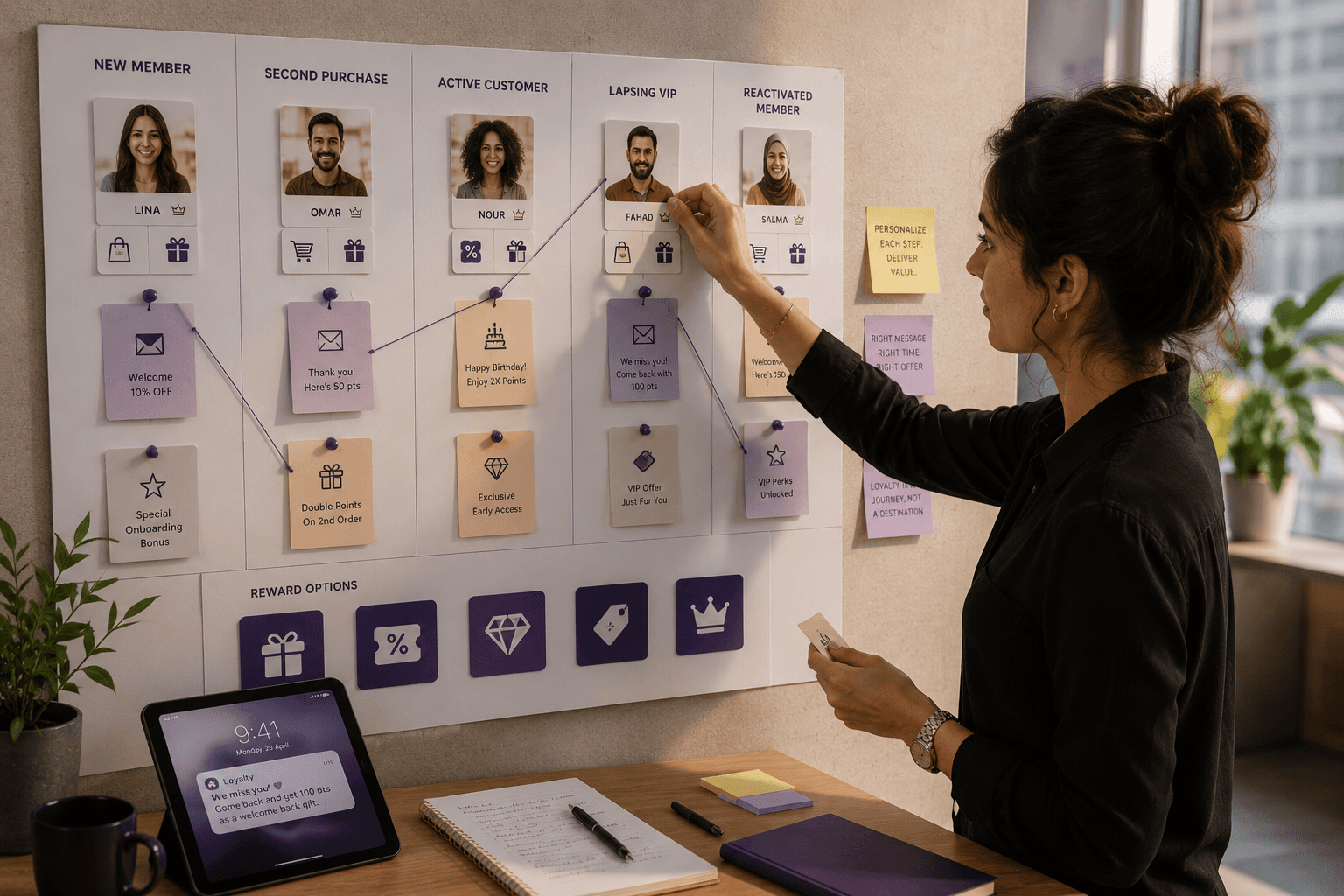
Second-purchase accelerator (post-first purchase)
Onboarding sequence (first 14 days)
Lapse prevention (early warning)
Reactivation (lapsed 60/90/120 days)
VIP care (high-touch recovery, not generic coupons)
If you’re building these flows now, also see: Real-time loyalty activation: what to automate first and AI personalization for loyalty: next-best-action basics.
Step 8: Plan campaigns around Saudi shopping rhythms
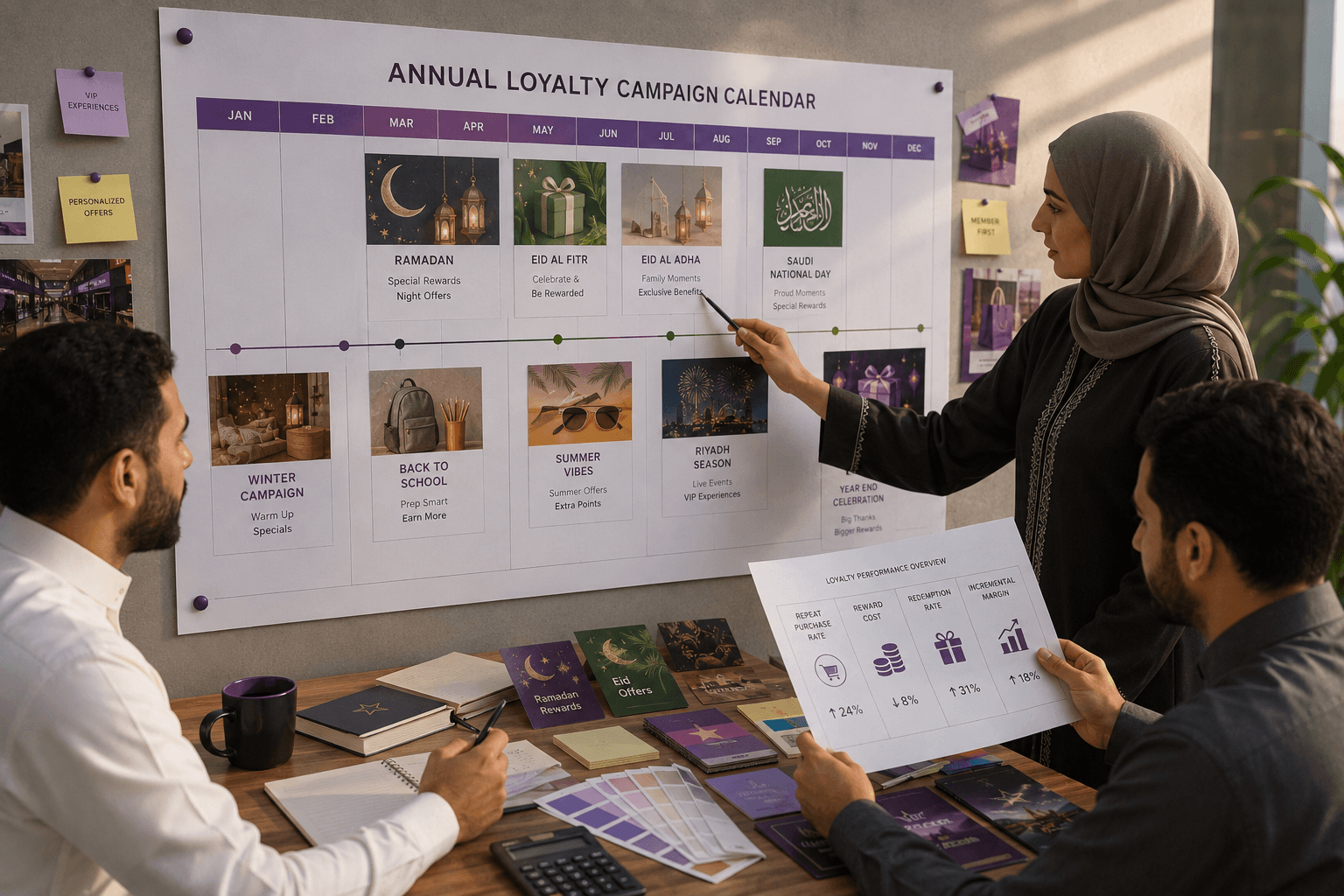
Instead of “monthly campaigns,” build a loyalty calendar around local moments and operational lead time.
Common KSA rhythms:
Ramadan (late-night shopping, grocery stock-up, gifting)
Eid al-Fitr (fashion, beauty, gifting)
Eid al-Adha (travel, family dining)
Saudi National Day (limited drops, patriotic moments)
Back-to-school (family baskets)
Riyadh Season / entertainment periods (destination + dining)
Operationally, plan 4–8 weeks ahead so you have time for segmentation, rewards budgets, Arabic/English messaging, and post-campaign measurement.
Step 9: Use channels with clear roles (don’t spam every channel)
A practical channel-role map:
App push: short nudges, progress, time-sensitive offers (keep messages brief).
SMS: OTP, transactional updates, critical expiry alerts (treat as high-signal).
Email: statements, tier summaries, richer content (batch + personalize).
WhatsApp/messaging: service and conversational flows (where operationally/legal appropriate); avoid turning it into pure promo spam.
In-app inbox: personalized offers archive + redemption history (reduces repeated SMS/push).
POS receipt/QR: acquisition + receipt-to-reward capture (critical for store-heavy brands).
Step 10: Measure loyalty as economics (not vanity metrics)
In KSA, sign-ups can grow fast—especially with strong incentives. But the real question is profitability.
Track a simple measurement stack:
Adoption metrics
Enrollment rate by channel
Active member rate (30/90 days)
Redemption rate and time-to-first-redemption
Behavior metrics
Repeat rate (2nd purchase)
Frequency and time-between-purchases
Cross-category rate
Economics metrics
Incremental margin from loyalty-driven behavior
Cost-to-serve (rewards + discounts + ops)
Points liability and breakage
Fraud/abuse rate (duplicate accounts, suspicious redemptions)
If you can’t estimate incremental value, you’ll struggle to defend budget—especially when finance teams see loyalty as a discount engine.
A practical 30–60–90 day rollout plan
Days 0–30: Foundations
Define architecture (owned/hybrid), identity plan, and minimum data fields.
Draft reward rules, expiry policy, and “plain language” terms.
Implement consent and preferences.
Days 31–60: Activation
Build onboarding + second-purchase flow.
Launch 2–3 core segments.
Establish reporting for adoption + economics.
Days 61–90: Optimization
Add seasonal calendar campaign.
A/B test reward value presentation.
Add partner utility only if your owned experience is working.
Common mistakes to avoid in Saudi loyalty programs
Launching an isolated points program with weak redemption options.
Hiding reward value (customers don’t know what points are worth).
Over-incentivizing sign-ups without a second-purchase plan.
Treating PDPL compliance as a post-launch fix.
Failing to unify identity across store + ecommerce.
Running every campaign as a discount blast instead of segmentation + lifecycle.
If you’re building or rebuilding loyalty in KSA, start with a Loyalty + Customer Data Audit: identity unification, consent design, reward economics, and 3 lifecycle flows (onboarding, second purchase, lapsed recovery).
If you want, CXForge can help you map the data model, segmentation plan, and activation playbook before you commit to integrations.
FAQ
What is the best loyalty program model in Saudi Arabia?
For most mid-market retail and hospitality brands, a hybrid model works best: build an owned member identity + data layer, then add selective partner redemption for utility.
Do Saudi loyalty programs need to be mobile-first?
Yes. Customers expect fast enrollment, balance checks, and redemption on mobile—often at the point of purchase.
How should points and rewards be explained to customers in KSA?
Make value obvious: show points-to-SAR value when possible, highlight what a member can redeem today, and clearly communicate expiry rules.
How does Saudi Arabia’s PDPL affect loyalty marketing?
Loyalty programs should treat consent and preference management as foundational: record consent, support opt-out, and keep messaging aligned with stated purposes.
What should a Saudi loyalty program measure to prove ROI?
Go beyond sign-ups. Track second purchase rate, frequency, redemption behavior, and unit economics (incremental margin minus rewards cost and liability).
Should KSA brands join ecosystem loyalty programs like Qitaf?
Ecosystems can add redemption utility and reach, but brands should still maintain an owned identity and customer data layer to personalize and measure outcomes.