Loyalty Data Privacy: A Practical Guide for Loyalty Programs
Updated on:

Key findings
Loyalty data privacy is not only a legal issue. It is a trust, retention, personalization, and operating-risk issue.
Loyalty programs should collect only the data needed for a clear customer or business purpose, then connect it to consent, preferences, and suppression rules.
Privacy-first personalization works when customers understand the value exchange: better rewards, relevant offers, easier service, and more control.
Consent and preference management are different. Consent answers whether a brand is allowed to process or contact; preferences answer how the customer wants the relationship to work.
A secure loyalty platform should support identity controls, role-based access, audit trails, data retention rules, partner permissions, incident processes, and reporting.
Publish Agent should verify jurisdiction-specific legal claims before publication because privacy obligations vary by country, state, industry, and data type.
Loyalty programs create a direct exchange: customers share identity, purchase behavior, preferences, and engagement signals; brands use that data to recognize them, reward them, and personalize the relationship.
That exchange only works when customers trust the brand with their data.
For loyalty, CRM, retention, ecommerce, hospitality, F&B, travel, and DTC teams, loyalty data privacy should not be treated as a legal appendix added after launch. It should shape the program design: what data you collect, why you collect it, how consent is captured, how preferences are honored, how partners can use shared data, and how the team proves that the program is safe to operate.
This guide explains the practical side of loyalty data privacy in plain English. It is not legal advice. It is an operating framework for teams that want personalization, segmentation, and rewards data to improve retention without creating avoidable trust or compliance risk.
What is loyalty data privacy?
Loyalty data privacy is the way a brand collects, stores, protects, governs, and uses customer data inside a loyalty program.
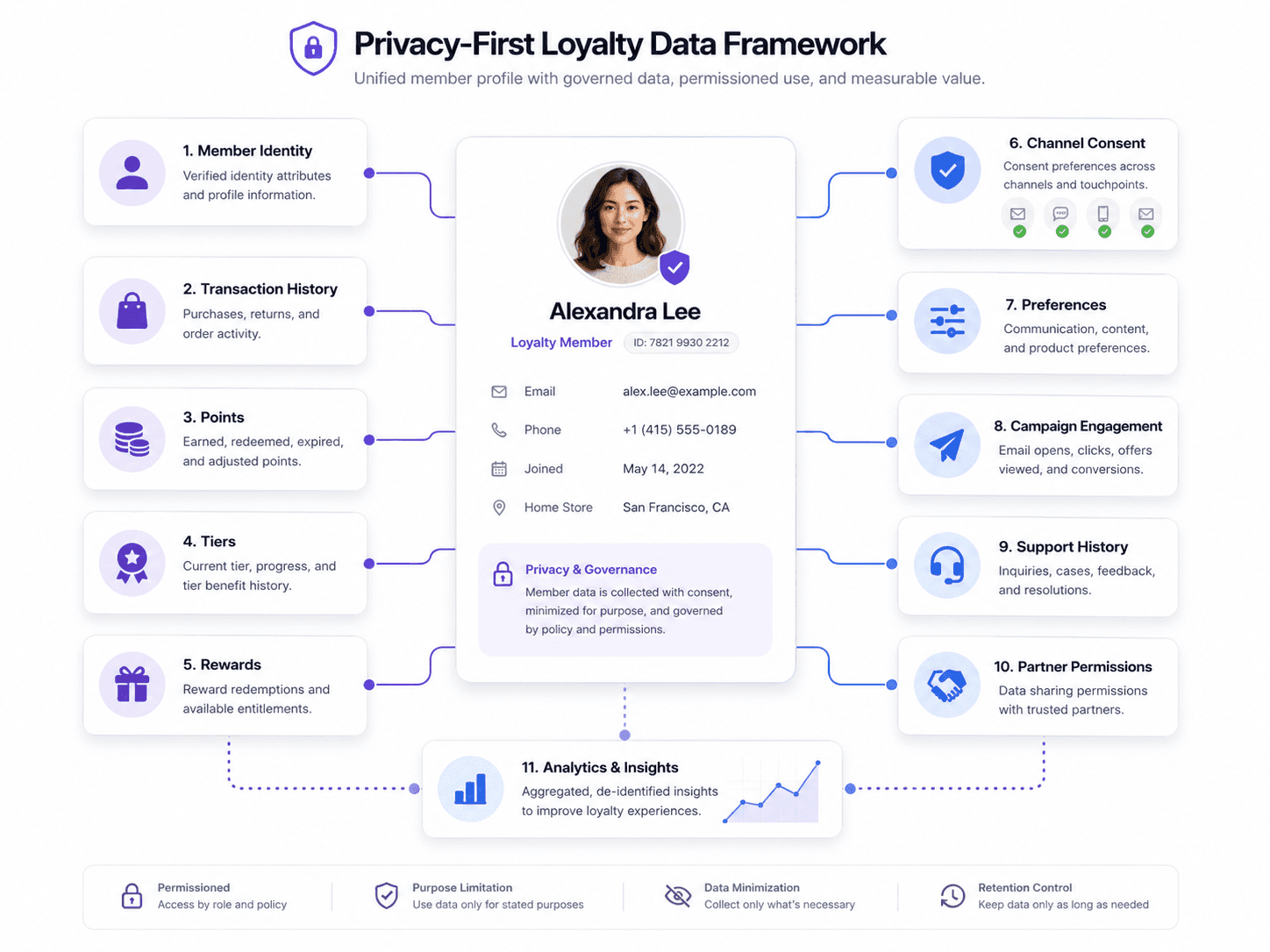
It usually covers:
member identity, such as name, email, phone, member ID, and account links
transaction and booking history
points, tiers, rewards, vouchers, cashback, or benefits
channel consent for email, SMS, WhatsApp, push, wallet updates, or direct mail
preference data, such as favorite categories, dietary preferences, preferred store, travel interests, or sizes
campaign engagement and lifecycle behavior
support, fraud, refund, and manual adjustment history
partner earn, burn, transfer, pooling, or account-linking permissions
analytics, segmentation, and personalization rules
The goal is not to stop using customer data. The goal is to use it responsibly, securely, transparently, and only where it supports a real customer relationship.
Why privacy matters more in loyalty than in generic marketing
Loyalty programs often hold richer data than standard marketing tools.
A newsletter platform may know that a customer opened an email. A loyalty platform may know when the customer joined, how often they buy, what they buy, which rewards they redeem, how close they are to a tier upgrade, whether their family account is linked, whether a partner transaction occurred, whether points are about to expire, and whether customer service adjusted their balance.
That depth creates opportunity. It also creates responsibility.
Loyalty data use | Customer value | Privacy risk if handled poorly |
|---|---|---|
Points balance and tier status | Clear recognition and rewards | Broken trust if balances are wrong or exposed |
Purchase history | Relevant offers and product recommendations | Creepy personalization if the customer did not expect it |
Preferences | Better experiences and fewer irrelevant messages | Overcollection if preferences are not used or explained |
Partner activity | More places to earn or redeem | Unclear data sharing across brands |
Location or store behavior | Localized offers and service | Sensitive tracking perception |
Family or linked accounts | Easier shared rewards | Permission conflicts between account members |
The privacy standard for loyalty should therefore be higher than "can we technically collect this?" The better question is: "Can we explain why we collect this, protect it, and use it in a way customers would recognize as fair?"
The privacy-first loyalty data model
A privacy-first loyalty program starts with purpose.
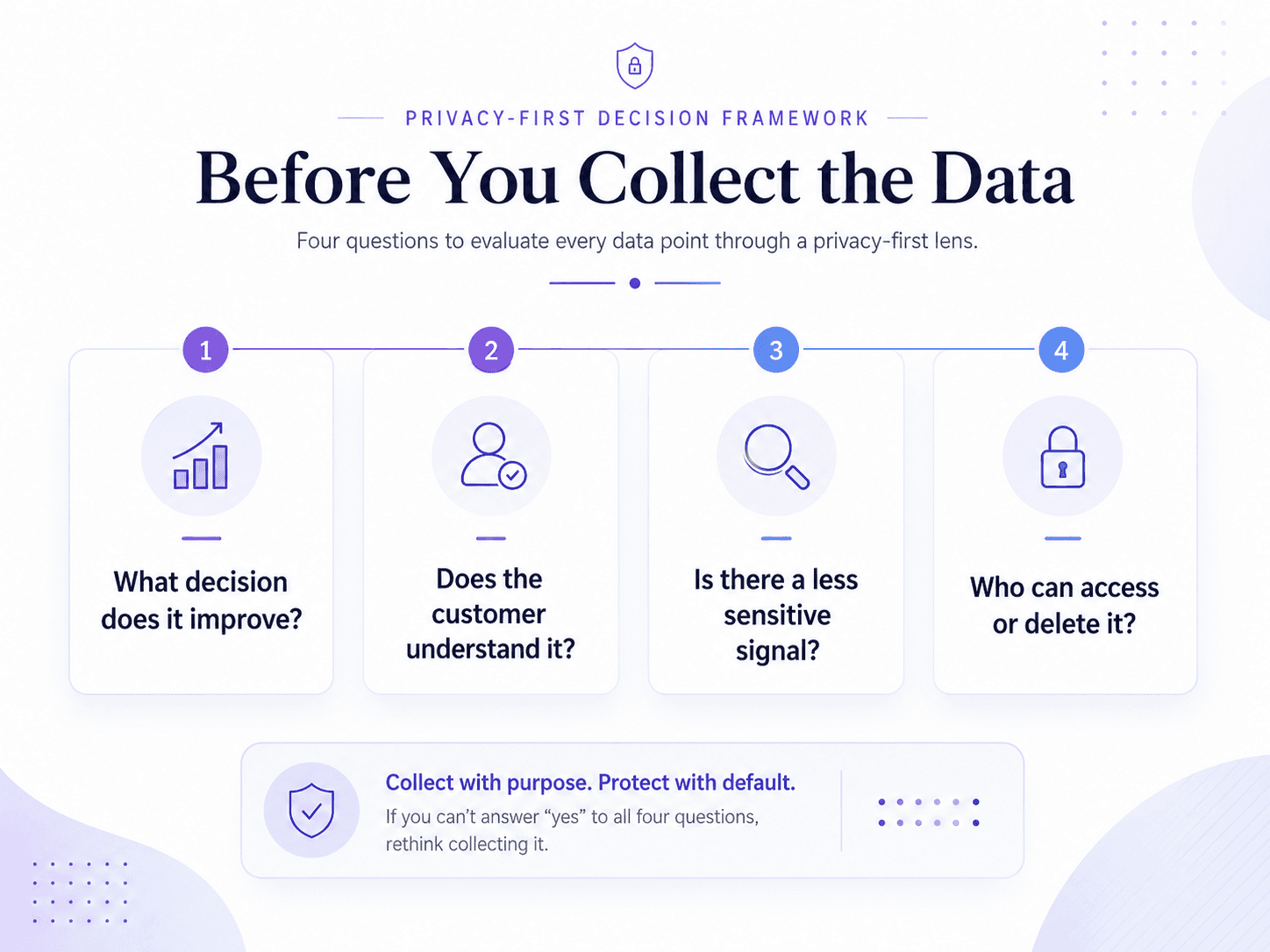
Before adding a field to signup, a profile, a preference center, or a partner integration, ask four questions:
What customer or business decision will this data improve?
Does the customer understand why we are asking for it?
Do we need this exact field, or would a less sensitive signal work?
Who can access it, activate it, share it, or delete it?
That keeps the program from becoming a data hoarding exercise.
Core fields most loyalty programs need
Most loyalty programs need a practical base profile:
member ID
email or phone, depending on enrollment channel
consent and communication permissions
enrollment date
loyalty status, points balance, rewards, and tier
purchase or visit history where relevant
redemption history
lifecycle stage
channel preference
data source and last-updated timestamp
Fields to treat more carefully
Some fields can be useful, but they deserve stricter purpose and access controls:
date of birth, especially if full date is not required
household, family, or child-related account data
exact location data
health, dietary, religious, financial, or other sensitive traits
government identifiers
inferred attributes such as income band, pregnancy status, or health conditions
fraud or abuse flags
partner-shared transaction detail
If a loyalty team cannot explain the customer benefit, retention use case, access policy, and retention period for a field, it probably should not collect it yet.
Consent is not the same as preference
One common loyalty mistake is mixing consent and preference into one vague checkbox.
Consent is about permission. Preference is about relevance.
Concept | Plain-English question | Loyalty example |
|---|---|---|
Consent | Are we allowed to process or contact this customer in this way? | The member opts in to receive SMS reward alerts. |
Preference | What does the customer want the experience to look like? | The member prefers shoe offers, weekend reminders, and pickup notifications. |
Suppression | Should this customer be excluded even if they otherwise qualify? | The member is opted out of SMS, has a support issue, or should not receive discount offers. |
Purpose | Why are we using this data? | Points-expiry reminder, tier recognition, service recovery, or product recommendation. |
For loyalty teams, this matters because personalization often sits at the intersection of all four. A customer might share a favorite category but decline SMS. They might allow email but not partner data sharing. They might want reward reminders but not promotional newsletters.
A strong loyalty platform should keep those distinctions visible so campaigns can honor them automatically.
Practical consent moments in a loyalty program
Consent should not be buried only in legal copy. It should appear at the moments where the customer makes choices.
Useful consent and transparency moments include:
loyalty enrollment
email, SMS, WhatsApp, push, or wallet opt-in
preference-center updates
partner account linking
points pooling or family account invitations
data sharing for coalition or multi-partner rewards
location-based or store-triggered offers
referral programs
sweepstakes, contests, or gamified campaigns
customer service account changes
data export, deletion, or unsubscribe requests
The best programs make these moments short, clear, and operationally connected. If a customer opts out of SMS in the preference center, that suppression should reach campaign workflows, loyalty triggers, and support tools.
How to make privacy-first personalization useful
Privacy-first personalization does not mean generic marketing. It means using the right data for the right purpose with clear controls.
Good examples:
A customer with expiring points receives an email that shows their balance and easy redemption options.
A VIP member gets early access because their tier qualifies, not because the brand inferred a sensitive trait.
A restaurant guest who chose "vegetarian" in preferences receives suitable menu rewards.
A hotel member receives a stay-anniversary message based on booking history and active email consent.
A retail member near a tier threshold receives a progress reminder with the exact spend gap.
Poor examples:
A brand collects birth date, household size, income, exact location, and favorite categories at signup before explaining the benefit.
A customer opts out of SMS but continues receiving triggered texts from a disconnected loyalty tool.
A partner receives detailed purchase history when the customer only expected points earning.
A campaign reveals an inference the customer never shared directly.
A loyalty team keeps obsolete data because no one owns retention rules.
The pattern is simple: use data the customer understands, honor the channel rules, and make the benefit obvious.
What a secure loyalty platform should support
Loyalty data privacy depends on both policy and software capability.
When evaluating a loyalty platform, CDP, or retention stack, ask whether it supports:
Capability | What to look for | Why it matters |
|---|---|---|
Role-based access | Different permissions for marketing, support, finance, stores, partners, and admins | Limits unnecessary exposure of loyalty data |
Consent and preference model | Structured fields for channel consent, partner permissions, preferences, and suppressions | Keeps campaigns compliant with customer choices |
Audit logs | Records of profile changes, balance adjustments, reward issues, exports, and admin actions | Helps investigate errors, fraud, and support disputes |
Data minimization | Ability to avoid collecting or syncing unnecessary fields | Reduces risk and operational clutter |
Retention rules | Ability to archive, anonymize, or delete data based on policy | Prevents indefinite storage by default |
Encryption and secure transfer | Protected data at rest and in transit | Reduces exposure if systems are accessed improperly |
Identity controls | Duplicate management, account merge rules, and account-link permissions | Prevents wrong-profile personalization and account conflicts |
Partner data controls | Purpose-limited sharing, settlement views, and partner-specific access | Critical for coalition, travel, and multi-partner loyalty |
Incident response support | Exportable logs, owner visibility, and support workflows | Helps teams act quickly when something goes wrong |
Reporting | Consent coverage, opt-out trends, data quality, and campaign suppression reporting | Turns privacy into an operating metric |
Security labels alone are not enough. The platform should help the loyalty team run privacy-aware workflows day to day.
Partner, coalition, and travel loyalty need stricter rules
Data privacy becomes more complex when more than one brand participates.
In a coalition loyalty program, travel rewards platform, mall program, payment-linked rewards ecosystem, or multi partner loyalty program, the customer may interact with several brands while expecting one loyalty experience.
That creates hard questions:
Which brand is the customer giving consent to?
Which partners can see transaction details?
Can partners use loyalty data for their own marketing?
Is the shared data used only for earning, redemption, settlement, and support?
Can a customer unlink an account without losing unrelated benefits?
How are data requests, deletion requests, or complaints handled across partners?
Who owns fraud investigation and balance adjustment decisions?
Partner loyalty should separate operational data from marketing data. A fuel partner may need to confirm that points were earned. It may not need full customer purchase history across every other partner. A hotel partner may need tier eligibility. It may not need every campaign segment the customer belongs to.
For related operating models, see CXForge's guides to multi-partner loyalty programs, linked loyalty programs and points pooling, and travel loyalty platforms.
A practical loyalty data governance checklist
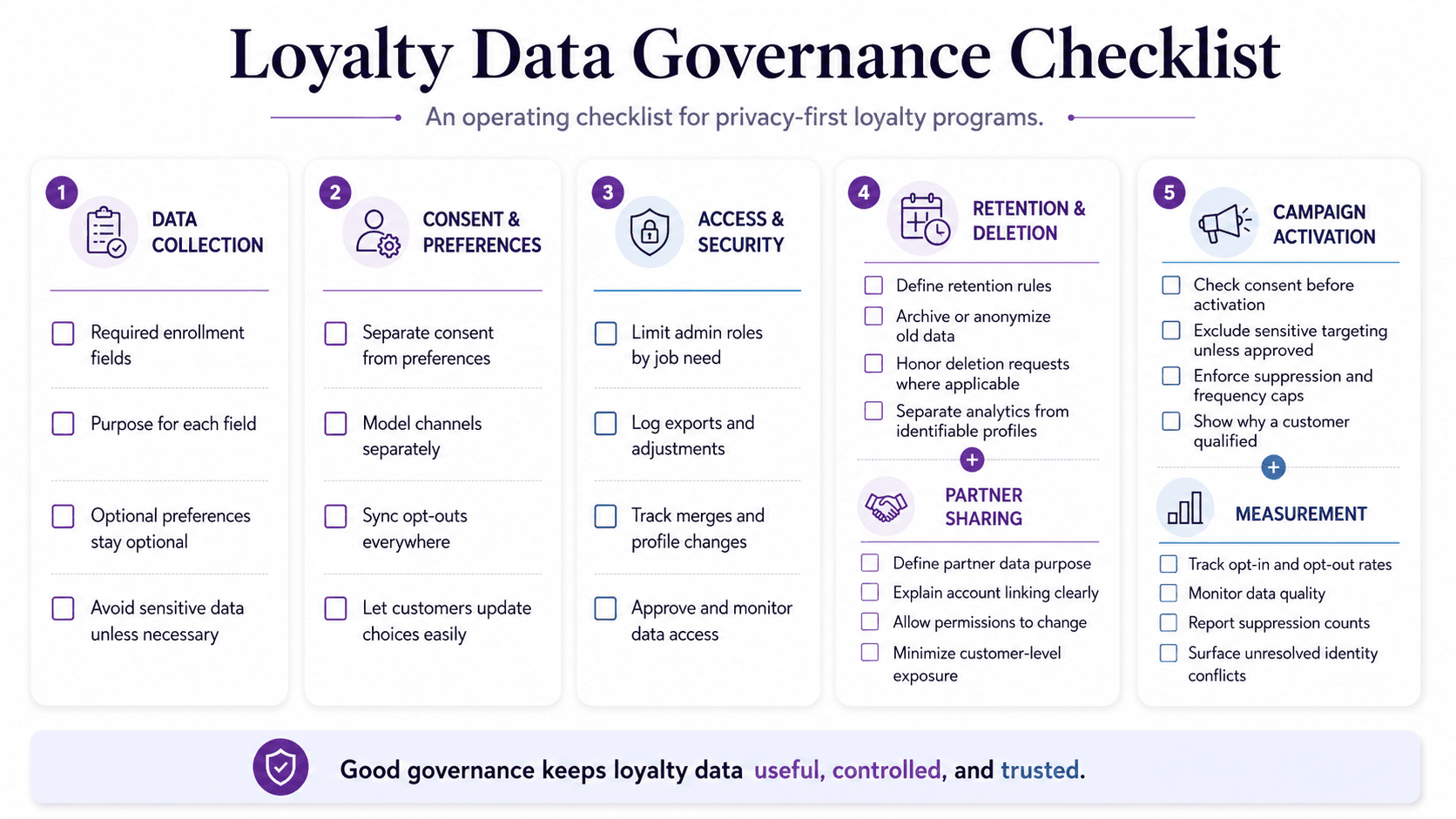
Use this checklist before launching a new program, migrating platforms, adding a partner, or expanding personalization.
Data collection
Do we know which fields are required at enrollment and which can be collected later?
Can we explain the purpose of every high-risk field?
Are optional preferences clearly optional?
Are we avoiding sensitive data unless there is a strong reason and proper control?
Consent and preferences
Are consent fields separate from preferences?
Are email, SMS, WhatsApp, push, wallet, and partner permissions modeled separately?
Do opt-outs sync to every campaign and loyalty workflow that needs them?
Can customers update preferences without contacting support?
Access and security
Are admin roles limited by job need?
Can store staff see only what they need to serve the customer?
Are balance adjustments, exports, and profile merges logged?
Are data exports limited, approved, and tracked?
Retention and deletion
Do we have rules for inactive accounts, expired rewards, old campaigns, support notes, and deleted profiles?
Can we preserve financial and fraud records where required while honoring customer requests where applicable?
Are anonymized analytics separated from identifiable customer profiles?
Partner and third-party sharing
Do partner contracts define data purpose, retention, access, and marketing rights?
Can customers understand what linking an account means?
Can partner permissions be withdrawn or changed?
Are settlement reports designed to avoid unnecessary customer-level exposure?
Campaign activation
Do segments check consent before activation?
Are sensitive attributes excluded from campaign targeting unless approved?
Are frequency caps and suppression rules enforced?
Can marketers see why a customer qualified for a campaign?
Measurement
Do dashboards track opt-in rate, opt-out rate, preference completion, suppression counts, data quality, and unresolved identity conflicts?
Can the team measure whether privacy-first data collection improves engagement without overcollecting?
Common loyalty data privacy mistakes
Asking for too much at signup
Long enrollment forms hurt conversion and trust. Start with the minimum data needed to create the account and deliver the first benefit. Collect preferences later when there is a clear reason.
Treating consent as a static field
Consent changes. Customers unsubscribe, switch channels, link accounts, unlink accounts, move countries, or update preferences. A loyalty platform should treat consent as live operational data, not a historical note.
Letting partners see more than they need
Partner ecosystems can create value, but unnecessary data sharing creates risk. Define the smallest useful partner view for earn, burn, settlement, support, and reporting.
Personalizing from unclear inferences
Customers usually accept personalization when the input is obvious: points balance, tier, purchase history, stated preference, or reward eligibility. They are more likely to react badly when the brand exposes sensitive or surprising inferences.
Keeping old data forever
Old loyalty data may be useful for analytics, finance, fraud, or support. That does not mean it should remain identifiable and broadly accessible forever. Define what should be retained, archived, anonymized, or deleted.
Ignoring support workflows
Privacy controls fail when support teams cannot see consent status, cannot process requests, or manually override data without logs. Customer service is part of the privacy operating model.
How CXForge fits
CXForge is positioned around loyalty plus customer data. That matters because privacy-aware loyalty is not just a policy document. It is a connected operating model across member identity, rewards, consent, segmentation, campaigns, analytics, and partner rules.
For a retail, hospitality, F&B, travel, fintech, or DTC team, the practical goal is to keep loyalty data useful and controlled:
one customer profile instead of disconnected loyalty and campaign records
consent and preferences available inside segmentation and activation
loyalty events connected to retention journeys
reward and tier data visible enough for service, but not overexposed
reporting that shows both commercial outcomes and data-quality risks
If your team is planning a new loyalty program, switching platforms, adding partner rewards, or building more personalization into loyalty campaigns, start with the data model. The safest loyalty programs are designed around clear value exchange, clear permissions, and clear operational ownership.
FAQ
What is loyalty data privacy?
Loyalty data privacy is the way a brand collects, stores, protects, governs, and uses customer information inside a loyalty program. It covers member identity, rewards, purchases, consent, preferences, partner data, campaign activation, reporting, and retention rules.
What customer data does a loyalty program need?
Most loyalty programs need member identity, contact details where permitted, consent status, enrollment date, points balance, tier status, reward activity, purchase or visit history, redemption history, preferences, and lifecycle stage. Teams should avoid collecting fields that do not support a clear program purpose.
How is consent different from customer preference?
Consent is permission to process data or contact a customer in a specific way. Preference describes what the customer wants, such as favorite categories, preferred store, or preferred channel. A loyalty program needs both, but they should be stored and activated separately.
Can loyalty programs personalize offers while respecting privacy?
Yes. Privacy-first personalization uses data the customer understands, such as tier status, points balance, purchase history, reward eligibility, stated preferences, and active consent. The brand should avoid surprising inferences, unnecessary sensitive data, and campaigns that ignore opt-outs.
What should a secure loyalty platform include?
A secure loyalty platform should include role-based access, consent and preference controls, audit logs, encryption, secure data transfer, identity controls, retention rules, partner data permissions, export controls, and reporting for data quality and suppression.
Do coalition and partner loyalty programs create extra privacy risk?
They can. Multi-partner loyalty programs need clear rules for consent, data sharing, partner access, settlement reporting, account linking, opt-outs, and deletion requests. Each partner should only receive the data needed for the agreed purpose.